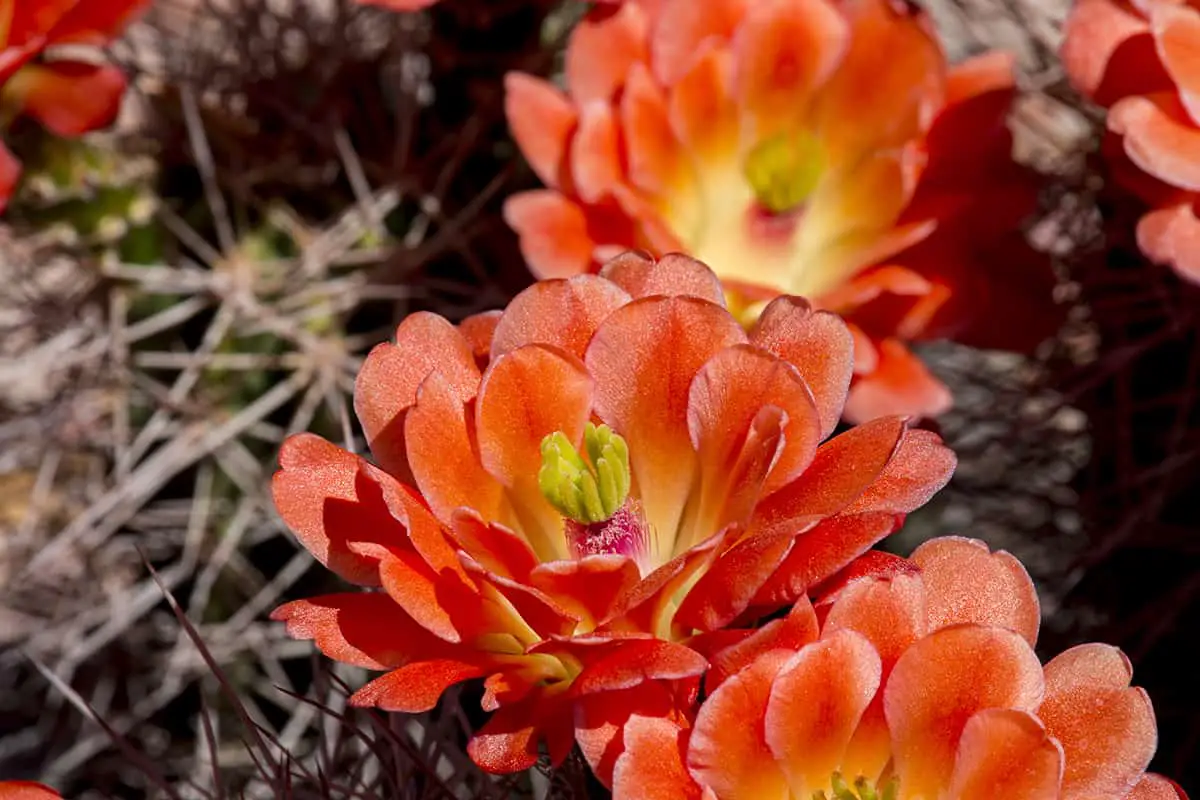
Orange is a common flower color among succulents, especially aloes, kalanchoes and ice plants.
Other succulents wear the color in their leaves. Strong sun and cool nights push coppertone sedum and ‘Campfire’ crassula to a glowing orange-red.
Fifteen warm-toned succulents are sorted out here, with honest notes on flower color wherever the orange shows up in the leaves alone.
Table of Contents
Orange Blooming Succulents
Aloe Maculata

Soap aloe (Aloe maculata) forms rosettes of broad, white-spotted leaves and sends up branched stalks of tubular orange to red-orange flowers, mainly in late winter and spring. Hummingbirds love them. It needs full sun to light shade and grows outdoors in zones 9 to 11.
Graptopetalum Paraguayense

Ghost plant (Graptopetalum paraguayense) has pale, pastel rosettes that blush pink in sun, and its starry spring flowers are white with red speckles rather than orange. For warm orange leaves in a similar shape, its hybrid Graptosedum ‘California Sunset’ glows a rich coppery orange in strong light.
Sedum Nussbaumerianum

Coppertone stonecrop (Sedum nussbaumerianum) earns its place with its leaves. Its rosettes glow copper-orange in full sun and cool weather, and its fragrant star-shaped flowers, in late winter and spring, are white.
Kalanchoe Blossfeldiana

Florist kalanchoe (Kalanchoe blossfeldiana) comes in vivid orange along with red, yellow, pink and white, and its dense flower clusters last for weeks. Six weeks of long, uninterrupted nights in fall prompt it to rebloom the following season.
Echeveria ‘Orange Monroe’

Echeverias send up arching stalks of bell-shaped flowers, frequently in coral and orange, and ‘Orange Monroe’ is grown for its orange-toned blooms in summer. Like all echeverias, it needs plenty of sun for compact growth and the best color.
Gasteria Bicolor

Gasteria bicolor carries arching stalks of small, tubular, coral-orange and green flowers, frequently more than once a year. Its tongue-shaped, spotted leaves grow well in partial shade, a good match for bright windowsills.
Aloe ‘Sunset’

Aloe ‘Sunset’ is a hybrid aloe prized for coral-orange flower spikes in summer over gray-green, toothed leaves. Strong sun deepens the leaf color to a warm, reddish tone.
Crassula Capitella ‘Campfire’

‘Campfire’ crassula (Crassula capitella ‘Campfire’) is all about its leaves, which glow a blazing red-orange in full sun and cool weather. Its flowers are small, white and star-shaped, in clusters in late summer.
Echinocereus Coccineus

Scarlet hedgehog cactus (Echinocereus coccineus) carries brilliant scarlet to orange-red, cup-shaped flowers in spring, pollinated by hummingbirds. It needs full sun and rocky, well-drained soil and handles cold winters in dry climates.
Rebutia Miniscula

Rebutia minuscula is a tiny, clustering cactus that covers itself in bright orange-red flowers in spring, frequently enough to hide the plant. A cool, dry winter rest triggers the best bloom.
Lampranthus Aureus

Lampranthus aureus, an ice plant from South Africa, smothers itself in glossy, golden-orange daisies in spring. Bees flock to them. It needs full sun and well-draining soil and grows outdoors in frost-free, dry-summer climates.
Delosperma Cooperi

Delosperma cooperi, the hardy ice plant, has shimmering magenta-pink flowers. For orange, its relatives are the better choice. ‘Fire Spinner’ combines orange and magenta, and the Wheels of Wonder series includes a bright orange form. All bloom for weeks in summer and handle cold winters in well-drained soil.
Sempervivum Tectorum

Common houseleek (Sempervivum tectorum) carries star-shaped pink to reddish-purple flowers in summer. For orange, look to relatives with warm-toned foliage. Cultivars such as ‘Terracotta Baby’ and ‘Gold Nugget’ glow orange-brown to golden in sun and cold weather. All grow in full sun and gritty, well-drained soil.
Orostachys Iwarenge

Chinese dunce cap (Orostachys iwarenge) forms small, silvery rosettes that stretch into cone-shaped spikes of white flowers in fall. It carries no orange at all, though its cool tones make a striking contrast beside orange-leaved succulents in a mixed pot. It needs sun and grows outdoors to zone 5.
Agave Parryi

Parry’s agave (Agave parryi) forms compact, blue-gray rosettes with dark spines. After many years, it sends up a tall stalk with red-orange buds that open into golden-yellow flowers, and the rosette dies afterward, leaving pups behind. It’s one of the most cold-hardy agaves, to about zone 5.