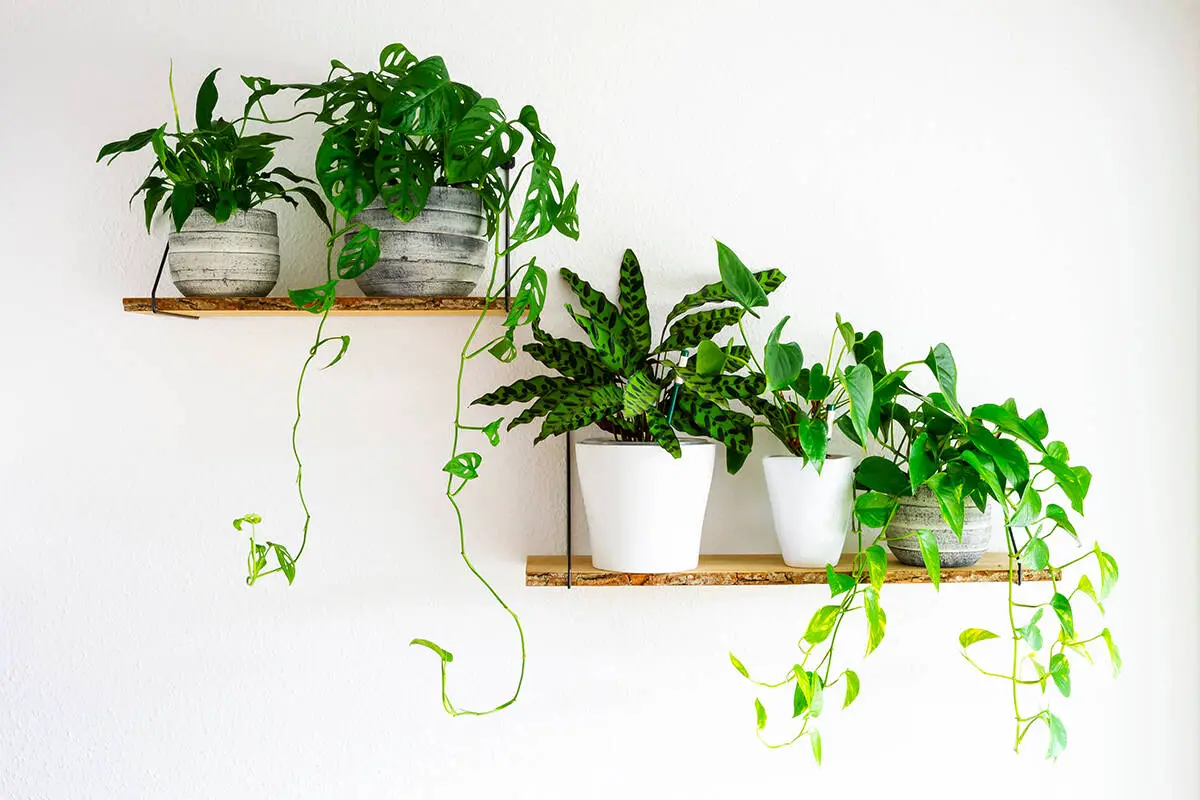
Every plant needs light to survive, and in a room with no windows, that light comes entirely from lamps and overhead fixtures.
The good news is that many tough, low-light houseplants grow steadily under artificial light alone. Bright LED or fluorescent fixtures left on for 10 to 12 hours a day, or an inexpensive LED grow light, are enough for most of them.
Snake plant and ZZ plant top the list of eighteen, and the fussier ferns and calatheas further down need extra light or humidity to grow well away from a window.
Table of Contents
- Snake Plant (Sansevieria Trifasciata)
- Zz Plant (Zamioculcas Zamiifolia)
- Peace Lily (Spathiphyllum)
- Pothos (Epipremnum Aureum)
- Philodendron
- Chinese Evergreen (Aglaonema)
- Cast Iron Plant (Aspidistra Elatior)
- Lucky Bamboo (Dracaena Sanderiana)
- Dracaena Corn Plant (Dracaena Fragrans)
- Maidenhair Fern (Adiantum)
- Boston Fern (Nephrolepis Exaltata)
- Spider Plant (Chlorophytum Comosum)
- Rubber Plant (Ficus Elastica)
- Calathea
- Prayer Plant (Maranta Leuconeura)
- Parlor Palm (Chamaedorea Elegans)
- Bird’s Nest Fern (Asplenium Nidus)
- Swiss Cheese Plant (Monstera Deliciosa)
Snake Plant (Sansevieria Trifasciata)

The Snake Plant, now classified as Dracaena trifasciata, is among the toughest choices for a windowless room. It’s native to tropical West Africa and goes by the nickname Mother-in-Law’s Tongue for its stiff, sword-like leaves.
Snake plants tolerate low light, dry air and long gaps between watering, and they grow slowly but steadily under ordinary office lighting. Water only when the soil is completely dry, roughly every three to four weeks, since overwatering is the most common way to lose one.
Varieties range from compact rosettes about 6 inches tall to upright types reaching 3 to 4 feet.
Zz Plant (Zamioculcas Zamiifolia)

The ZZ plant is famously hard to kill and handles low, artificial light well. Its glossy, dark green leaflets grow along upright, waxy stems, and the plant slowly reaches 2 to 3 feet tall and wide.
Native to eastern Africa and a member of the Araceae family, it stores water in thick underground rhizomes. That makes it highly drought-tolerant.
Plant it in a fast-draining potting mix, and water only when the soil is dry most of the way down. Overwatering rots the rhizomes. ZZ plants are toxic if eaten and belong out of reach of pets and children.
Peace Lily (Spathiphyllum)

The Peace Lily belongs to the Spathiphyllum genus, a group of about 40 species of tropical flowering perennials. Its dark green, glossy leaves look good year-round, and white, hooded flowers appear when it receives enough light.
Plants range from small 10-inch tabletop types to floor plants 3 feet tall or more. Peace lilies tolerate low light well, though in a windowless room they grow slowly and rarely bloom unless placed close to a bright lamp.
Peace lilies like more water than most low-light plants. They droop clearly when thirsty and recover within hours of watering. Feed at half strength a few times in spring and summer, and less in dim conditions. Peace lilies are toxic to cats and dogs.
Pothos (Epipremnum Aureum)

Pothos, also called Devil’s Ivy, is among the easiest trailing plants for low light. It grows steadily under fluorescent and LED office lights, though variegated forms lose part of their gold or white markings in dim conditions.
Water when the top inch or two of soil is dry, and avoid soggy soil, which causes root rot. Pothos tolerates average household humidity and recovers quickly from occasional neglect.
Grow it in a hanging basket or on a shelf with its vines trailing, or train it up a moss pole. Pothos is toxic to pets.
Philodendron

Philodendrons belong to the Araceae family and include both vining and upright types. Many tolerate low light, which makes them a common choice for offices and dim rooms.
The easiest is the heartleaf philodendron (Philodendron hederaceum), with dark green, heart-shaped leaves about 2 to 4 inches long. Its trailing vines look good on a shelf, a tabletop or a wall bracket.
Philodendrons grow well at normal room temperatures of 65°F to 80°F and tolerate average humidity. Plant them in a well-draining potting mix, and water when the top inch of soil is dry, with no water left in the saucer. Like other aroids, they’re toxic to pets.
Chinese Evergreen (Aglaonema)

The Chinese Evergreen (Aglaonema) is among the most tolerant plants for dim, artificially lit rooms. The genus, native to tropical Asia, includes about 21 species and many colorful hybrids.
Leaves range from solid green to silver, cream, pink and red patterns. Green and silver varieties handle low light best, and the pink and red types need brighter light to hold their color.
Plant it in a well-draining potting mix, and water when the top inch or two of soil dries. Aglaonema prefers warmth, above 60°F, and dislikes cold drafts. It’s toxic to pets.
Cast Iron Plant (Aspidistra Elatior)

The Cast Iron Plant earned its name by surviving low light, irregular watering and temperature swings. Native to Japan, this evergreen, clump-forming perennial grows upright, dark green leaves up to about 2 feet tall.
Plant it in a well-draining potting mix. Water when the top 2 to 3 inches of soil are dry, and empty the saucer afterward. Feed once in spring.
Its slow growth means it rarely needs repotting, and it’s a reliable, low-effort choice for dim corners and windowless spaces.
Lucky Bamboo (Dracaena Sanderiana)

Lucky Bamboo, or Dracaena sanderiana, is a Dracaena and no relation to true bamboo, despite the name and its segmented stalks.
The stalks are commonly trained into spirals or braids and sold in vases of water and pebbles. It prefers bright, indirect light, though it handles moderate artificial light well.
Grown in water, it needs enough to cover the roots at all times, and a water change every one to two weeks. Use filtered or distilled water, since chlorine and fluoride cause yellow leaf tips. In soil, water when the top inch dries. Feed with a very dilute liquid fertilizer every month or two. Lucky bamboo is toxic to cats and dogs.
Dracaena Corn Plant (Dracaena Fragrans)

The Corn Plant (Dracaena fragrans) is a tall, tree-like plant that tolerates low light, a good choice for a dim office or hallway.
Its long, arching, ribbon-like leaves grow from thick canes, and popular varieties such as ‘Massangeana’ carry a yellow-green stripe down the center of each leaf.
Water when the top inch or two of soil is dry, and avoid both soggy and bone-dry soil. Corn plants are sensitive to fluoride in tap water, which causes brown leaf tips, and filtered water or rainwater helps prevent it.
In a windowless room, a few weeks in brighter light every few months helps the plant recover its vigor. Dracaenas are toxic to cats and dogs.
Maidenhair Fern (Adiantum)

Maidenhair Fern (Adiantum) has delicate, lacy fronds on thin black stems and grows naturally in shaded woodland. It handles lower light well, though it’s among the fussier plants on this list.
The soil needs constant, even moisture, and even one dry spell crisps the fronds. Use a moisture-retentive, well-draining potting mix, and provide humidity of 50 percent or more. A humidifier helps far more than misting.
Avoid drafts, heating vents and sudden temperature changes. With steady moisture and humidity, it’s a beautiful choice for a windowless bathroom with good artificial light.
Boston Fern (Nephrolepis Exaltata)

Boston Fern, Nephrolepis exaltata, grows wild in humid forests of the Americas, such as those of Florida, Mexico, the West Indies and northern South America. Its lush, arching fronds make it a classic hanging plant.
It needs moderate light. Place it under strong artificial lighting or a grow light in a windowless room. Boston ferns prefer temperatures of 60°F to 75°F.
Humidity matters most. A windowless bathroom with a shower is a natural fit, and a humidifier or pebble tray helps elsewhere. Water whenever the soil surface begins to dry, since the fern dislikes drying out. Check occasionally for spider mites, scale and mealybugs.
Spider Plant (Chlorophytum Comosum)

The Spider Plant (Chlorophytum comosum) is a tough, adaptable plant from tropical and southern Africa that grows well under artificial light.
It forms arching mounds of narrow leaves, typically striped with white or cream. Healthy plants send out long stems with baby plantlets, which root easily into new plants.
Water when the top inch of soil starts to dry. Spider plants tolerate occasional over- and underwatering better than most, thanks to their thick, water-storing roots. Brown leaf tips point to fluoride in tap water or dry soil. Spider plants are nontoxic to cats and dogs, a plus for pet owners.
Rubber Plant (Ficus Elastica)

Rubber plants are native to Southeast Asia and have large, glossy, leathery leaves in dark green, deep burgundy or variegated shades of cream, pink and white.
They tolerate moderate light, though in a windowless room, they need a strong lamp or grow light. In dim conditions, growth slows, stems stretch and lower leaves drop. Use a well-draining mix and water when the top inch or two of soil is dry, since excess moisture causes root rot.
Rubber plants adapt to average household humidity. Wipe the large leaves with a damp cloth every few weeks to clear dust. Prune occasionally to control height and shape, and wear gloves, since the milky sap irritates skin. The plant is toxic to pets.
Calathea

Calatheas, now mostly reclassified under the genus Goeppertia in the Marantaceae family, are grown for their boldly patterned leaves. They tolerate lower light well and grow naturally on shady rainforest floors.
Popular types include the Rattlesnake Plant (Goeppertia insignis) and the Zebra Plant (Goeppertia zebrina), with dramatic stripes and patterns.
Like prayer plants, calatheas fold their leaves upward at night and open them in the morning, a movement that follows the light cycle.
Calatheas are fussier than most low-light plants. They need evenly moist soil, humidity of 50 percent or more and filtered or distilled water, since tap water minerals cause brown, crispy edges. They’re nontoxic to pets.
Prayer Plant (Maranta Leuconeura)

The Prayer Plant, native to the rainforests of Brazil, handles low light well. Its oval, patterned leaves fold upward in the evening like hands in prayer.
It grows best in bright, indirect light, or under strong artificial light in a windowless room, since direct sun fades the leaf patterns. Maintain temperatures of about 65°F to 75°F and humidity of 50 percent or more, ideally with a humidifier.
Plant it in a well-draining, peat- or coir-based mix, and hold the soil evenly moist with no soggy patches. Feed monthly in spring and summer with a balanced liquid fertilizer at half strength. Prayer plants are nontoxic to pets.
Parlor Palm (Chamaedorea Elegans)

Parlor Palm, Chamaedorea elegans, is native to the rainforest understory of southern Mexico and Guatemala. This small, compact palm tolerates low light and crowded roots, one reason it was a Victorian parlor favorite.
Water when the top inch of soil dries, and avoid letting it dry out completely, which causes brown leaf tips. Moderate humidity helps. Place it away from heating vents.
Feed lightly two or three times during spring and summer, and stop in winter, when growth slows. Repot only when necessary, typically every two to three years. Parlor palms are nontoxic to pets.
Bird’s Nest Fern (Asplenium Nidus)

This slow-growing, evergreen fern is native to tropical Asia, Australia, Hawaii and the Pacific islands, where it grows on tree branches and rainforest floors. Its natural shade makes it a good fit for low-light rooms.
The Bird’s Nest Fern has broad, wavy, apple-green fronds that grow in a rosette from a central crown, like a nest. It prefers shade and grows well under fluorescent or LED lighting.
It likes humidity, and a humidifier helps in dry rooms. Water the soil evenly around the edges, and avoid the central crown, which rots if water sits in it. Overwatering causes root rot. Let the top inch of soil dry slightly between waterings.
Despite its exotic look, it’s relatively easy to care for once its humidity and watering needs are met.
Swiss Cheese Plant (Monstera Deliciosa)

Monstera deliciosa, native to the rainforests of southern Mexico and Central America, is famous for its large, glossy leaves with splits and holes.
It tolerates medium light, though in a windowless room, it needs a strong grow light to grow well. In dim conditions, new leaves come in small and solid, with few or no splits.
Water when the top 1 to 2 inches of soil are dry, roughly weekly in summer and less in winter, since overwatering causes root rot. Monstera grows best between 65°F and 85°F with humidity around 50 to 60 percent. A humidifier helps in dry rooms.
Feed monthly in spring and summer with a balanced liquid fertilizer diluted to half strength. Remove yellow or damaged leaves at the base. Monstera is toxic to pets.