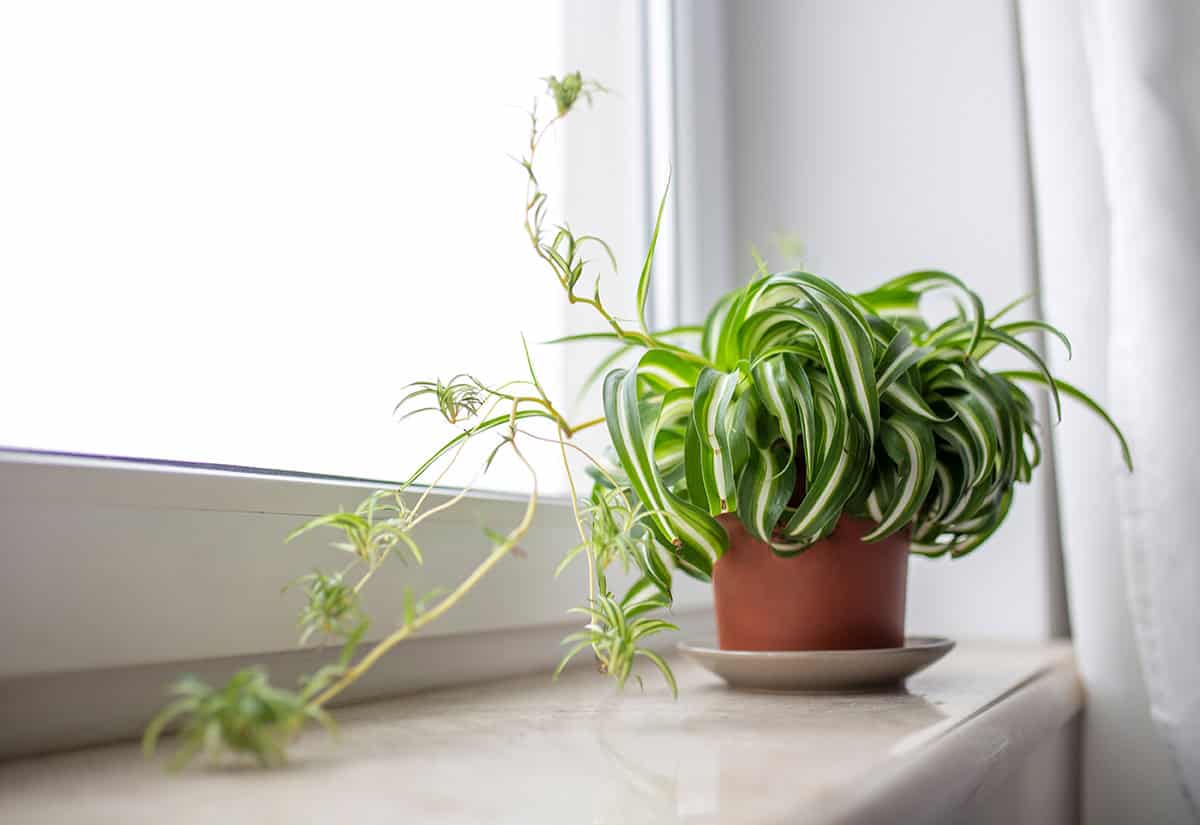
The spider plant on your grandmother’s windowsill was almost certainly ‘Vittatum’, with a creamy white stripe down each leaf. It’s one of dozens of named forms, and the wider Chlorophytum genus counts roughly 200 species.
Leaf curl, stripe placement and stem color are what separate them. Stripe placement is the easiest clue at the nursery, and the descriptions name it for every plant on the list.
Table of Contents
- Common Varieties of Spider Plants
- Chlorophytum Comosum ‘Vittatum’
- Chlorophytum Comosum ‘Variegatum’
- Chlorophytum Comosum ‘Bonnie’
- Chlorophytum Comosum ‘Hawaiian’
- Chlorophytum Comosum ‘Reverse Variegatum’
- Chlorophytum Comosum ‘Ocean’
- Chlorophytum Orchidastrum ‘Green Orange’
- Chlorophytum Comosum ‘Atlantic’
- Chlorophytum Capense
- Chlorophytum Laxum ‘Bichetii’
- Chlorophytum Laxum ‘Zebra’
- Chlorophytum Amaniense ‘Fire Flash’
- Chlorophytum ‘Mandarin’
- Chlorophytum Comosum ‘Curly’
- Cleome Hassleriana ‘Violet Queen’ (Purple Spider Plant)
Common Varieties of Spider Plants
Nearly every variety below shares the same easy care. Bright, indirect light and evenly moist, well-drained soil cover most of them, and the differences lie in leaf shape and color.
Chlorophytum Comosum ‘Vittatum’

‘Vittatum’ ranks among the most recognizable spider plants, with green leaves and a broad white stripe down the center. It grows fast in hanging baskets or pots and sends out plenty of plantlets. Bright, indirect light and well-drained soil cover its needs.
Chlorophytum Comosum ‘Variegatum’

‘Variegatum’ flips that pattern, with dark green centers and white edges. Medium light is enough, and it handles short dry spells, though steady watering produces the fullest plants.
Chlorophytum Comosum ‘Bonnie’

‘Bonnie’ has curly leaves striped like ‘Vittatum’, with a white center. Its compact size fits smaller spaces, and a hanging basket shows off the twisted foliage best.
Chlorophytum Comosum ‘Hawaiian’
‘Hawaiian’, also sold as ‘Golden Glow’, grows compact rosettes of green leaves with soft yellow or cream variegation. It handles low to medium light and likes regular watering. Its small size fits tabletops and desks.
Chlorophytum Comosum ‘Reverse Variegatum’
‘Reverse Variegatum’ carries a reversed stripe pattern compared with the standard variegated form, though nurseries label it inconsistently. It prefers bright, indirect light and moist, well-draining soil, and it grows into a large plant.
Chlorophytum Comosum ‘Ocean’

Short, arching leaves edged in white set ‘Ocean’ apart, and the plant grows compact and dense. It does well in indirect light with occasional feeding and evenly moist soil.
Chlorophytum Orchidastrum ‘Green Orange’
Despite the common name, ‘Green Orange’ belongs to a different species, Chlorophytum orchidastrum. Broad, glossy green leaves sit on vivid orange stems. It prefers medium to bright light and regular watering.
Chlorophytum Comosum ‘Atlantic’
‘Atlantic’ has slightly curled green leaves with white margins. Care matches other spider plants, with indirect light and well-drained soil.
Chlorophytum Capense

Chlorophytum capense has solid green leaves with no variegation. It adapts to many light levels, including shade, and shrugs off pests better than most. Its toughness makes it a smart choice for beginners.
Chlorophytum Laxum ‘Bichetii’

Commonly called siam lily, ‘Bichetii’ grows narrow green leaves with creamy white margins in a small, grassy clump. Its foliage is stiffer than the classic spider plant, and it grows in low to bright light. In warm climates, it edges garden beds as a ground cover.
Chlorophytum Laxum ‘Zebra’
‘Zebra’ grows narrow green leaves with white edges in tight clumps. Bright, indirect light and regular watering produce the best growth, and the striped leaves make a neat accent in mixed indoor gardens.
Chlorophytum Amaniense ‘Fire Flash’
Also sold as mandarin plant, ‘Fire Flash’ belongs to Chlorophytum amaniense. Its broad, dark green leaves rise from bright orange stems and leaf bases. It grows in low to medium light and prefers well-drained soil.
Chlorophytum ‘Mandarin’
‘Mandarin’ is a trade name used for orange-stemmed chlorophytums such as ‘Fire Flash’ and ‘Green Orange’. Plants sold under it have bright green leaves with orange stems and need moderate light and regular watering.
Chlorophytum Comosum ‘Curly’
‘Curly’ spider plants have twisted, curled leaves striped like ‘Vittatum’. A hanging basket displays them best, and indirect light with regular watering covers their care.
Cleome Hassleriana ‘Violet Queen’ (Purple Spider Plant)

Despite the common name, ‘Violet Queen’ is a cleome, an annual garden flower unrelated to true spider plants. It produces purple blooms with long, spidery stamens and grows best in full sun and well-drained soil.