Winter container garden ideas built around hardy evergreens, colorful stems, and cold-season foliage keep porch planters lively after summer flowers fade. A narrow spruce gives a pot height; trailing ivy softens its rim. Winter rain and freezing temperatures make drainage and plant hardiness as important as color. The combinations below show how those details shape each planting.
Table of Contents
- Dwarf Spruce With Cascading Ivy
- Blue Spruce And Burgundy Heuchera Pot
- Red-Twig Dogwood And Evergreen Branch Container
- White Birch Branch Winter Planter
- Hellebore And Evergreen Winter Bowl
- Ornamental Kale And Dwarf Conifer Container
- Golden Cypress And Purple Winter Foliage
- Juniper And Winterberry Container
- Skimmia And Ivy Winter Pot
- Boxwood Sphere With Layered Winter Foliage
- Mugo Pine And Ornamental Grass Planter
- Snow-Dusted Evergreen And Heather Pot
- Evergreen Sedge And Hellebore Mix
- Dwarf Pine With Burgundy And Silver Foliage
- Winterberry And White Pine Arrangement
- Mini Evergreen Forest Container
- Wintergreen And Fern Porch Pot
- Blue Juniper And White Ornamental Cabbage
- Tall Arborvitae With Layered Base Planting
- Bare Branches With Ornamental Kale And Ivy
- Hinoki Cypress With Moss And Hellebores
- Red-Twig Dogwood And White Hellebore Pot
- Ornamental Cabbage And Blue Fescue Winter Bowl
- Dwarf Spruce With Pinecone Mulch
- Heather And Small Conifer Cluster
- Yellow-Twig Dogwood And Blue Spruce Container
- Mixed Evergreen Trough With Winter Berries
- Black Planter With Silver And Evergreen Foliage
Dwarf Spruce With Cascading Ivy
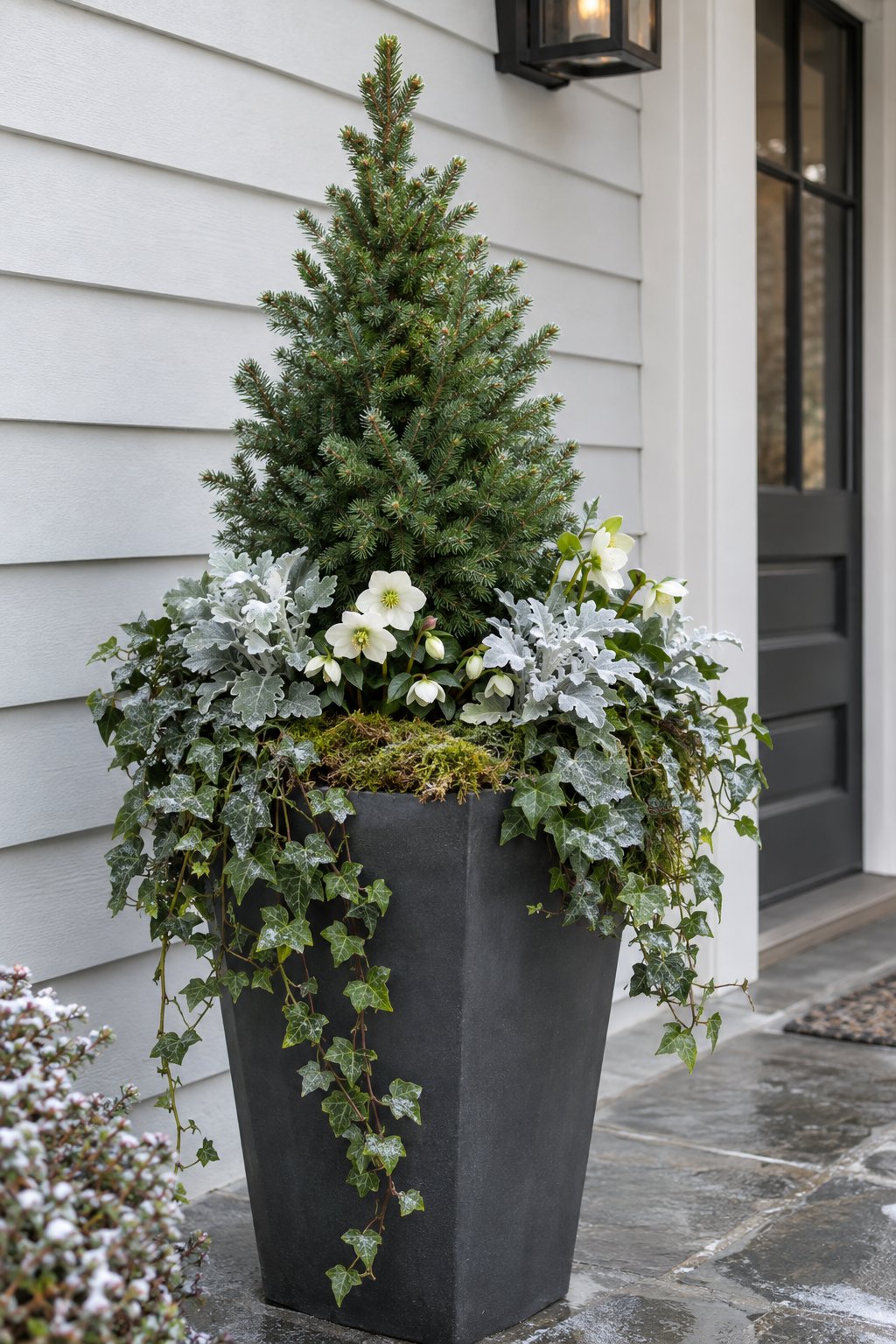
A compact spruce gives a front-step planter a clear silhouette, and ivy softens its edges without hiding the tree. Set the spruce slightly behind center in a deep pot, leaving room for ivy near the front rim. Choose a spruce cultivar whose mature width fits the container.
Ivy remains evergreen in many regions, though exposed foliage may brown during severe cold. A sheltered position and a frost-resistant pot help the planting through winter. Keep ivy stems trimmed away from the spruce’s lower branches.
Blue Spruce And Burgundy Heuchera Pot
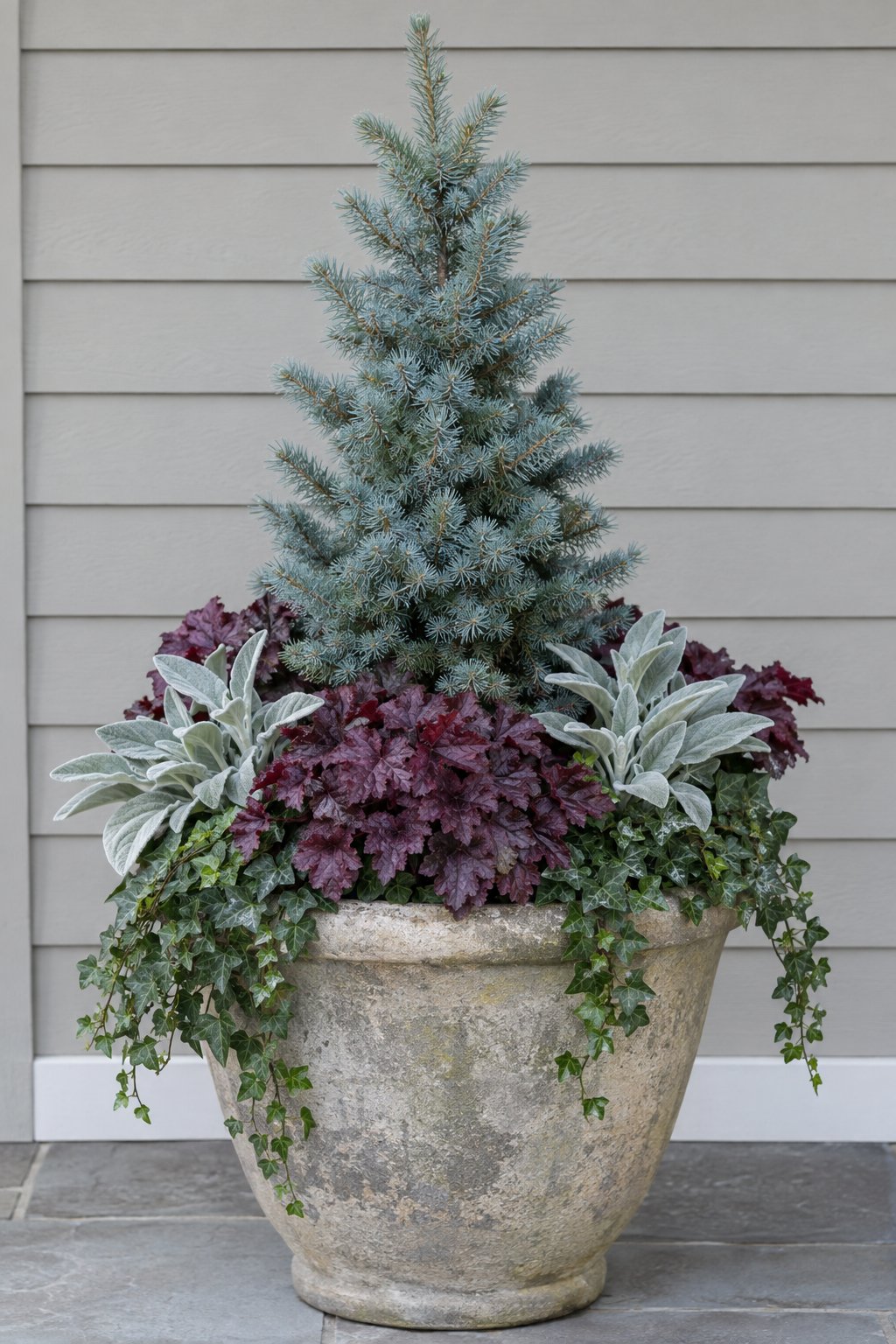
Silvery-blue needles gain depth beside the dark, rounded leaves of burgundy heuchera. A young, compact blue spruce anchors this pairing, with heuchera planted far enough from the trunk to leave its lower branches visible. A charcoal or weathered stone container keeps the colors distinct.
Heuchera crowns are vulnerable in soggy soil. Set them at soil level in a pot with open drainage holes, then check moisture during dry spells. In colder areas, protect the container from repeated freezing and thawing.
Red-Twig Dogwood And Evergreen Branch Container
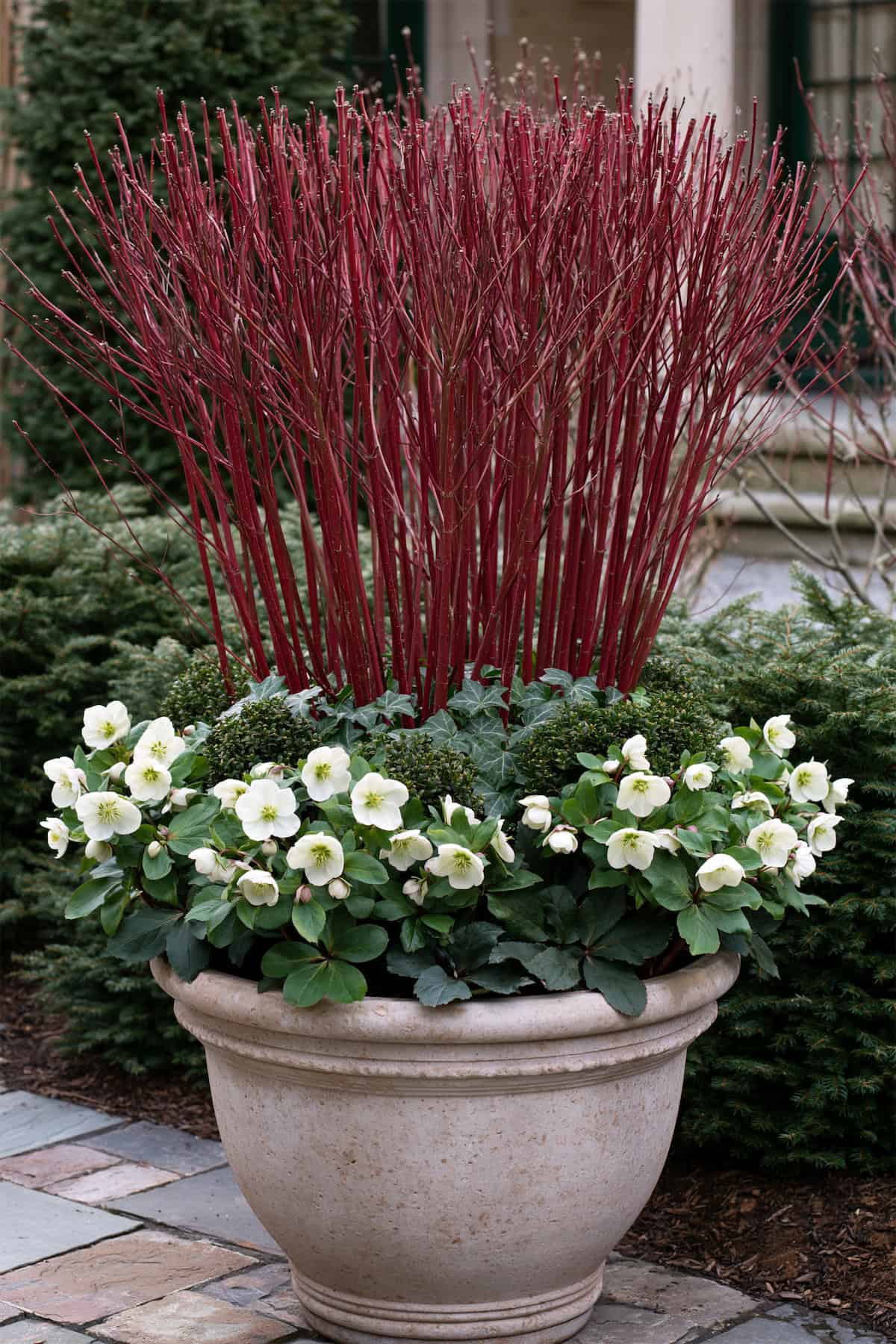
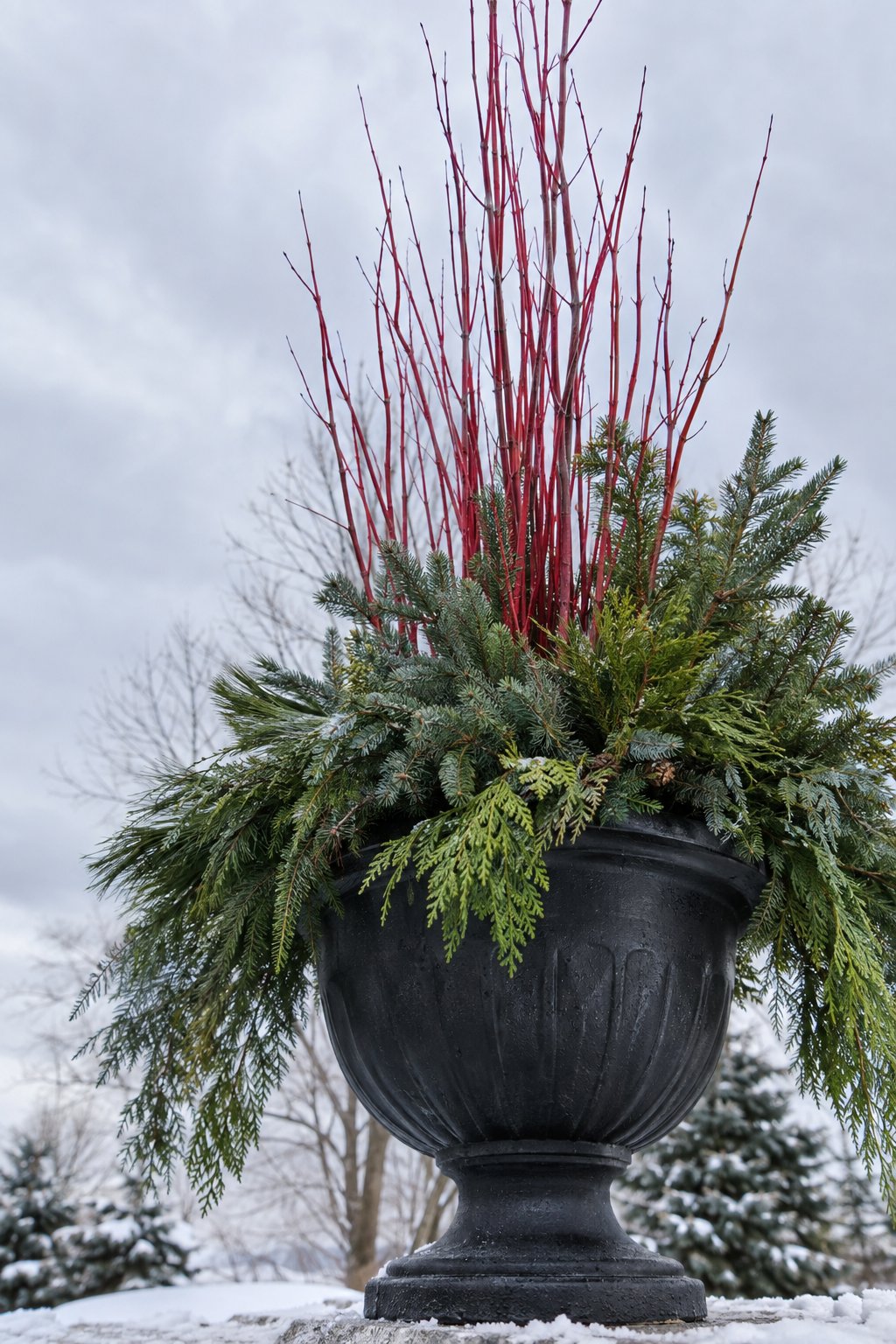
Scarlet stems give a winter planter height even after every leaf has fallen. Insert freshly cut red-twig dogwood branches into damp potting mix or a firmly packed base, then tuck cedar or fir boughs around their lower ends. The greenery conceals the mechanics and spreads beyond the rim.
This is a cut arrangement, not a rooted planting. Its stems stay attractive through cold weather, though evergreen branches eventually dry in sun and wind. Replace brittle boughs as needed, leaving the dogwood structure in place.
White Birch Branch Winter Planter
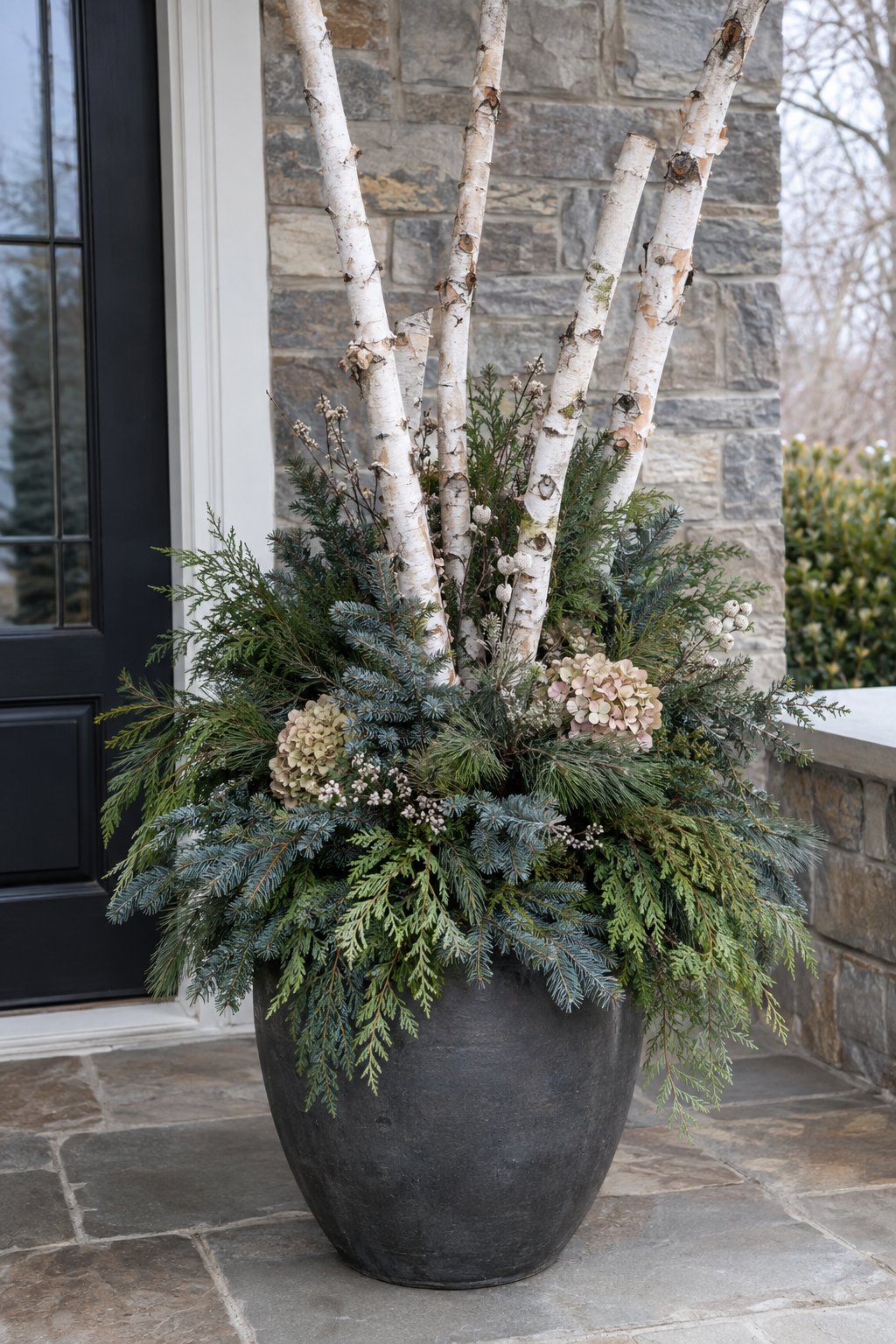
Against a dark front door, upright birch branches stand out through their pale bark and fine black markings. Group several cut branches at varied heights near the center of a substantial pot. Short evergreen boughs at their base keep the stems secure and cover the fill beneath.
Birch branches have little visual weight, so the container needs enough width or ballast to resist wind. If the pot contains soil, drainage remains important: standing water expands when frozen and may crack vulnerable materials.
Hellebore And Evergreen Winter Bowl
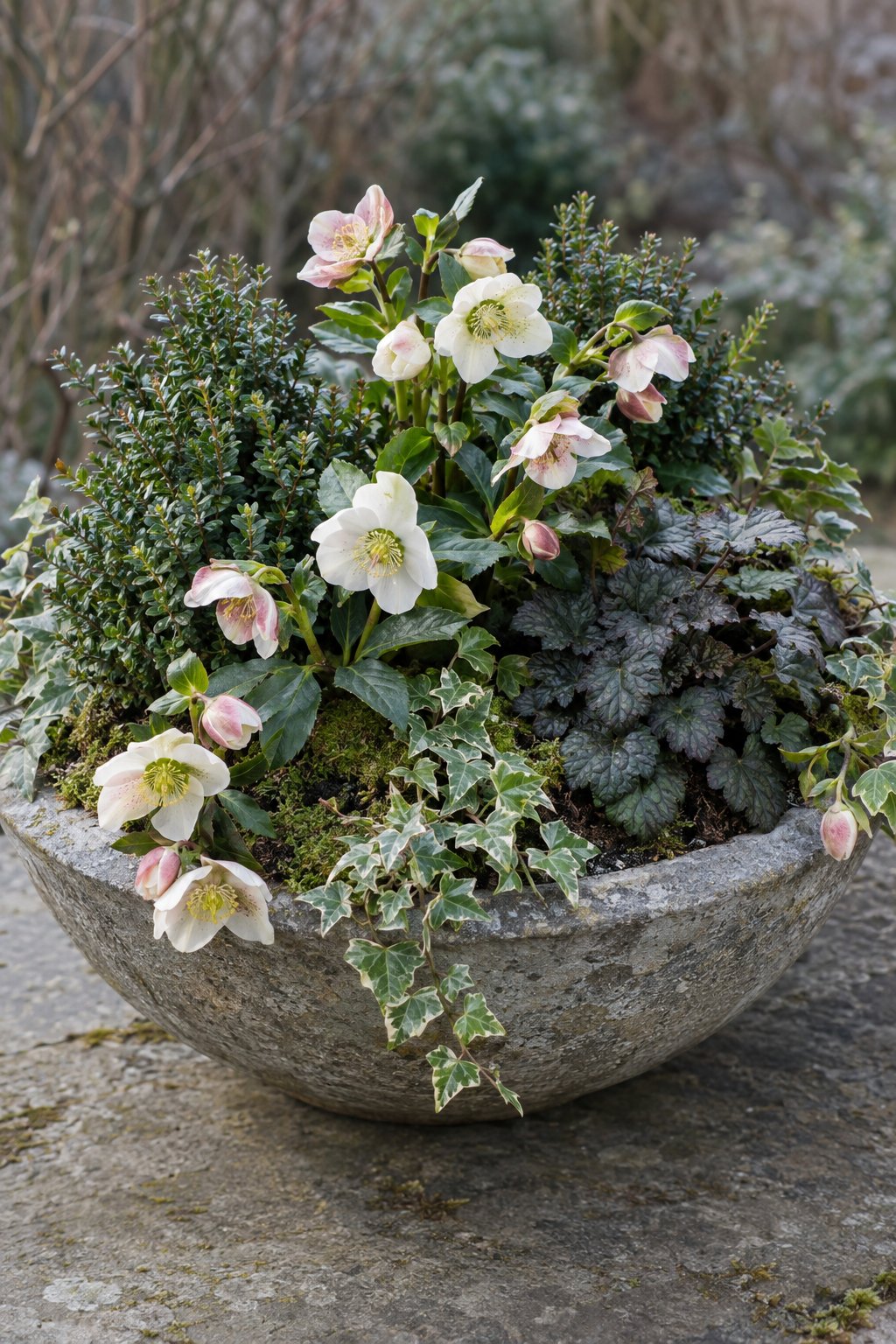
A low bowl puts hellebore flowers where their downward-facing blooms are easier to see. Position a hardy hellebore near the front edge, backed by a compact evergreen such as a small juniper. Leave space around the crown; buried hellebore crowns are prone to decline in damp conditions.
Flowering time varies by cultivar and climate, with many hellebores blooming in late winter or early spring. The evergreen holds the composition during the weeks before buds open. Place the bowl near a sheltered doorway where its blooms remain visible at close range.
Ornamental Kale And Dwarf Conifer Container
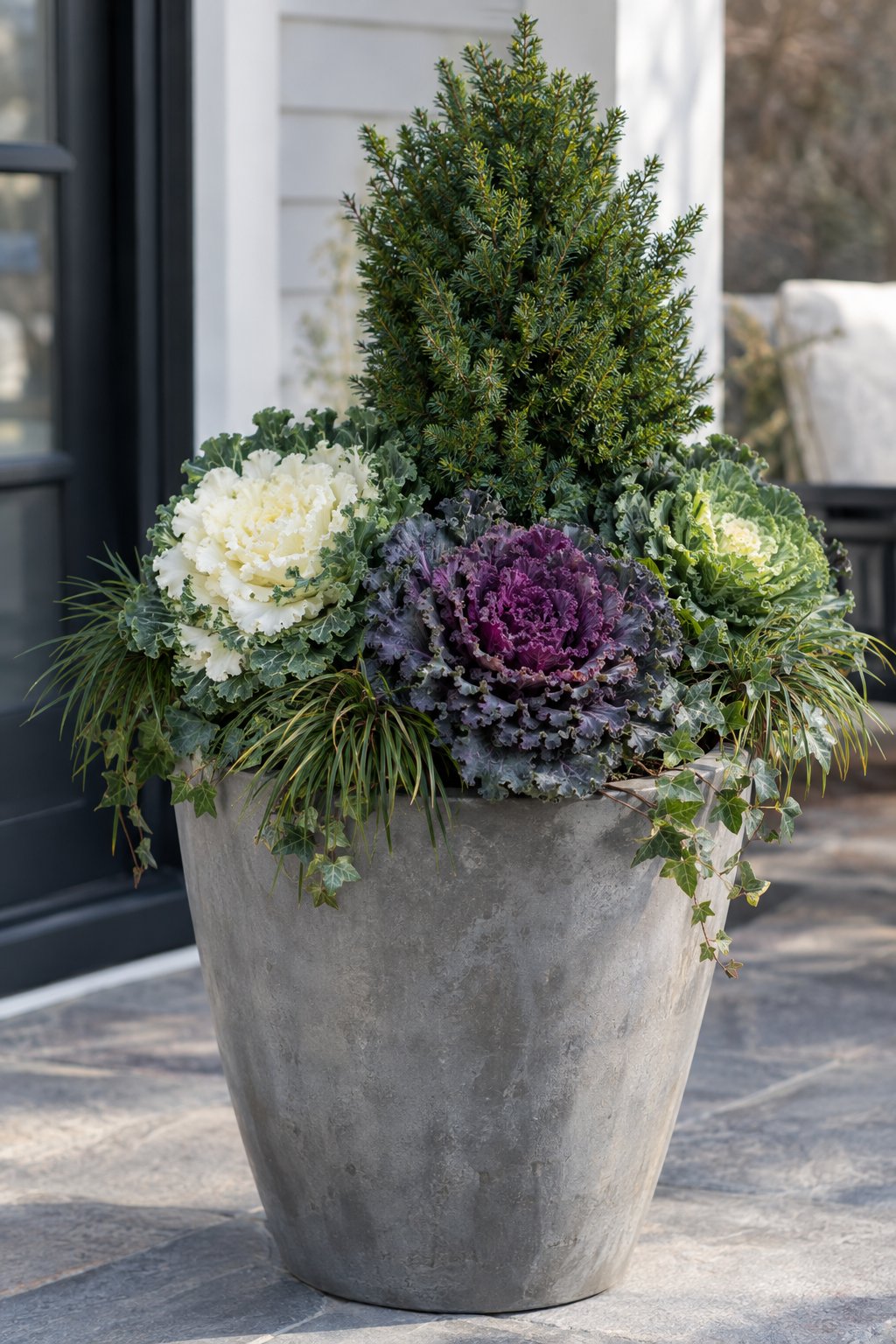
Broad kale rosettes give a squat conifer a generous base without obscuring its shape. Arrange two or three ornamental kale plants around a dwarf conifer in a wide container, allowing each rosette room to expand. Purple-centered varieties look striking beside deep green needles.
Cool weather intensifies ornamental kale’s color, but sustained hard freezes eventually damage its leaves. In regions with severe winters, treat the kale as seasonal planting and leave the conifer in place after removal. Clear away collapsed leaves promptly to keep the crown dry.
Golden Cypress And Purple Winter Foliage
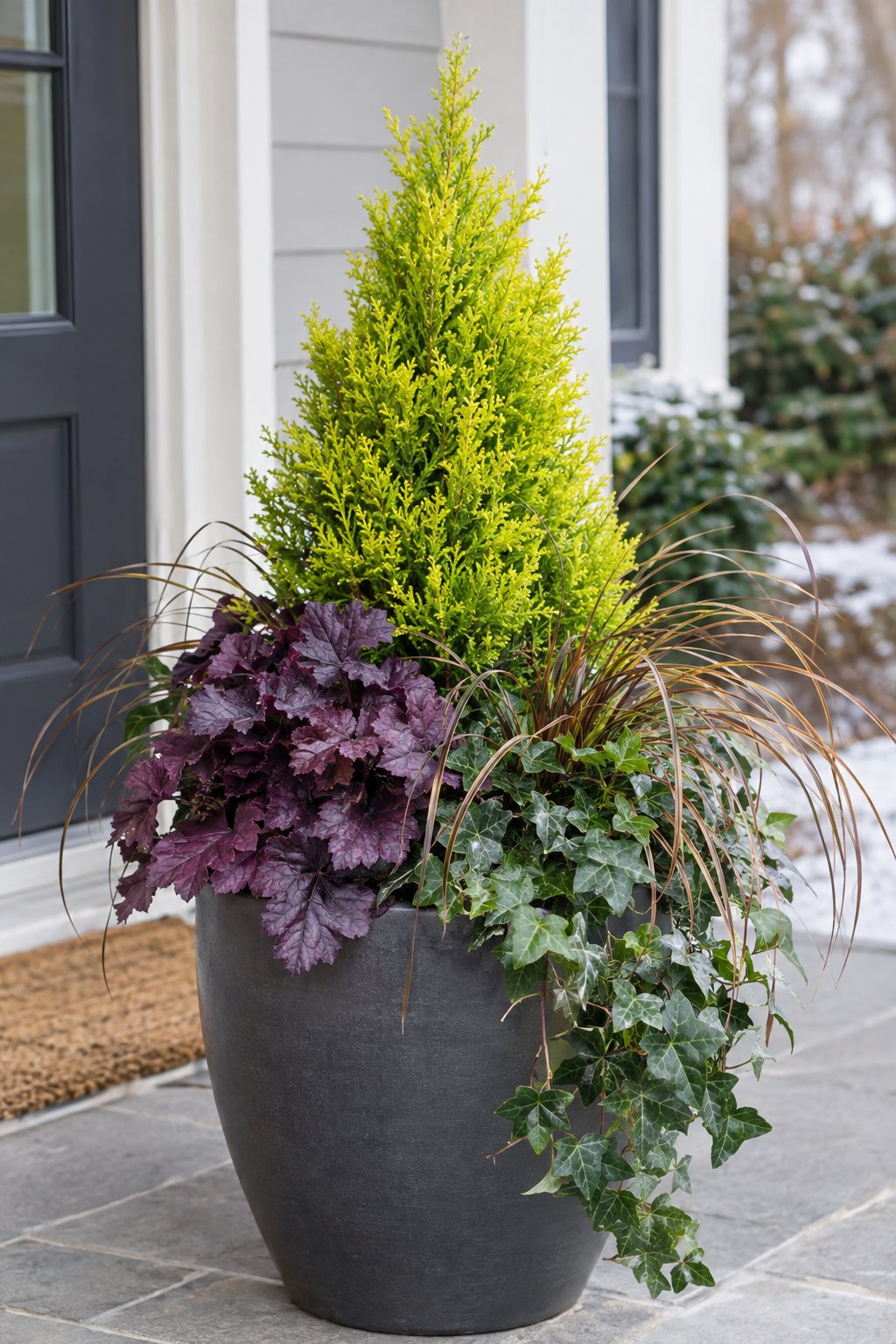
Late-afternoon light catches the yellow-green foliage of a golden cypress, giving this pot a bright focal point through short days. Place a compact cultivar toward the rear and ring its base with purple heuchera. The low leaves emphasize the cypress’s upright form.
Golden cypress needs a cultivar matched to local winter temperatures; hardiness varies widely. In exposed sites, winter sun and wind may dry the foliage even when the soil is cold. Check the root ball during rain-free periods, watering when the upper soil has dried.
Juniper And Winterberry Container
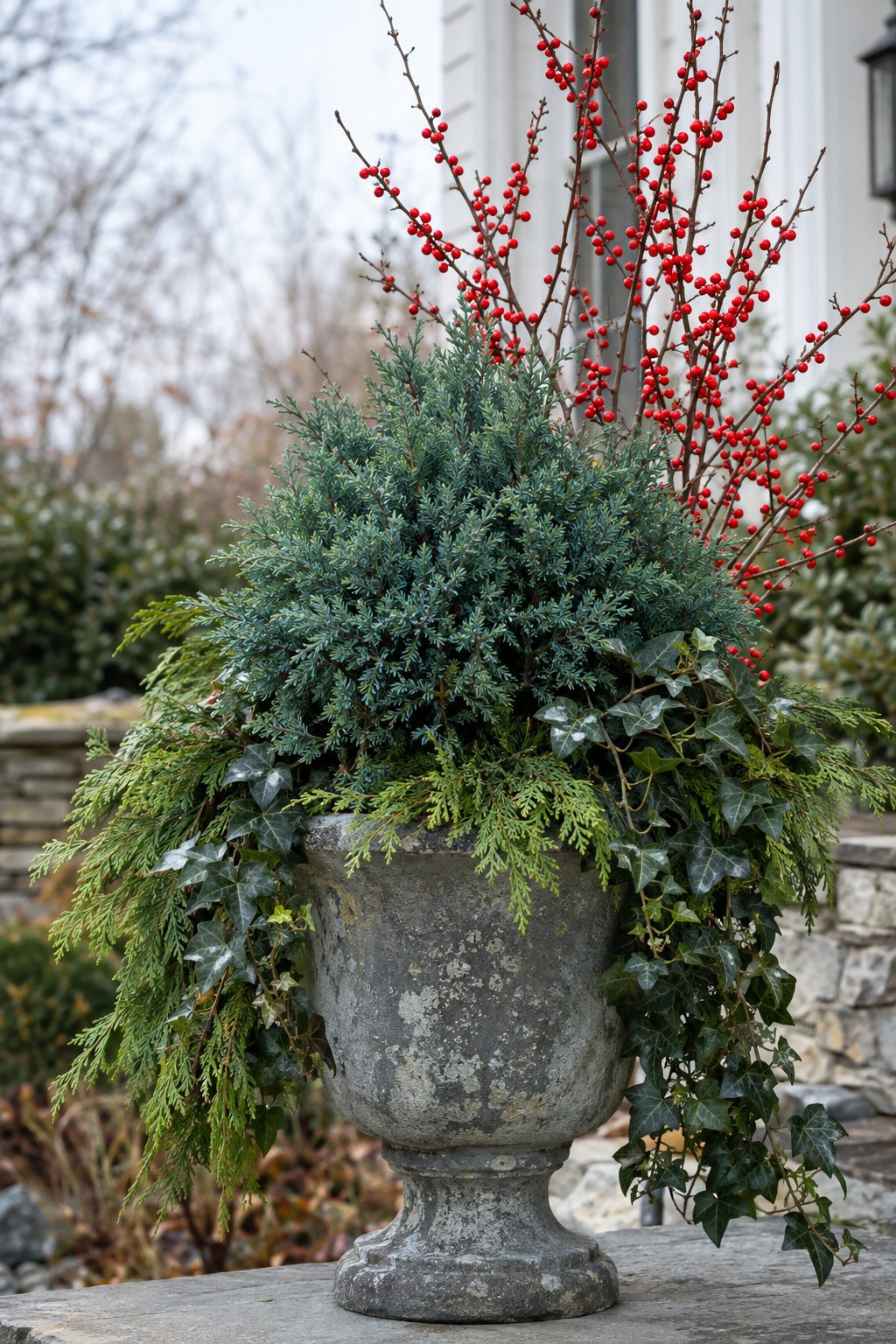
Blue-green juniper needles give winterberry’s red fruit a restrained backdrop. A low juniper planted at the front of the pot leaves space for cut winterberry branches behind it. Insert the berry stems firmly into the mix, placing them where their branching shape remains visible.
Cut winterberry avoids the space and pollination requirements of a fruiting shrub in a container. Berries may attract birds, and dropped fruit needs clearing from walkways. The juniper remains as a living planting after the stems have passed their prime.
Skimmia And Ivy Winter Pot
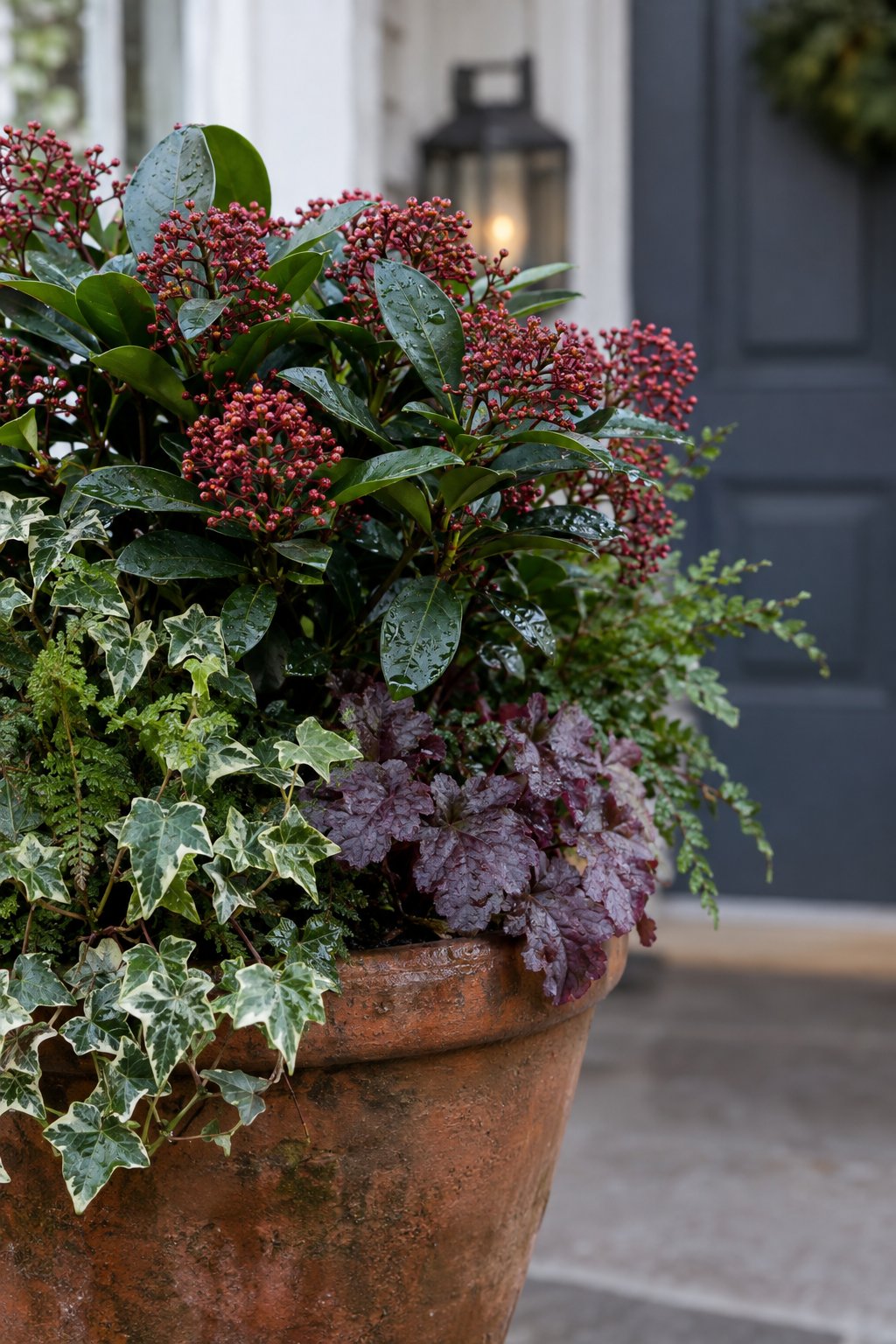
A shaded porch is a useful setting for skimmia, whose glossy leaves and clustered buds remain prominent in winter. Give the shrub the center of an acid-friendly potting mix and plant ivy near the edge, where it trails without crowding the skimmia’s roots.
Skimmia favors shelter from harsh afternoon sun and bitter wind. Its cold tolerance varies by cultivar, so local hardiness matters before it goes into an exposed container. Keep the mix lightly moist through dry winter stretches; evergreen leaves continue losing water in cold weather.
Boxwood Sphere With Layered Winter Foliage
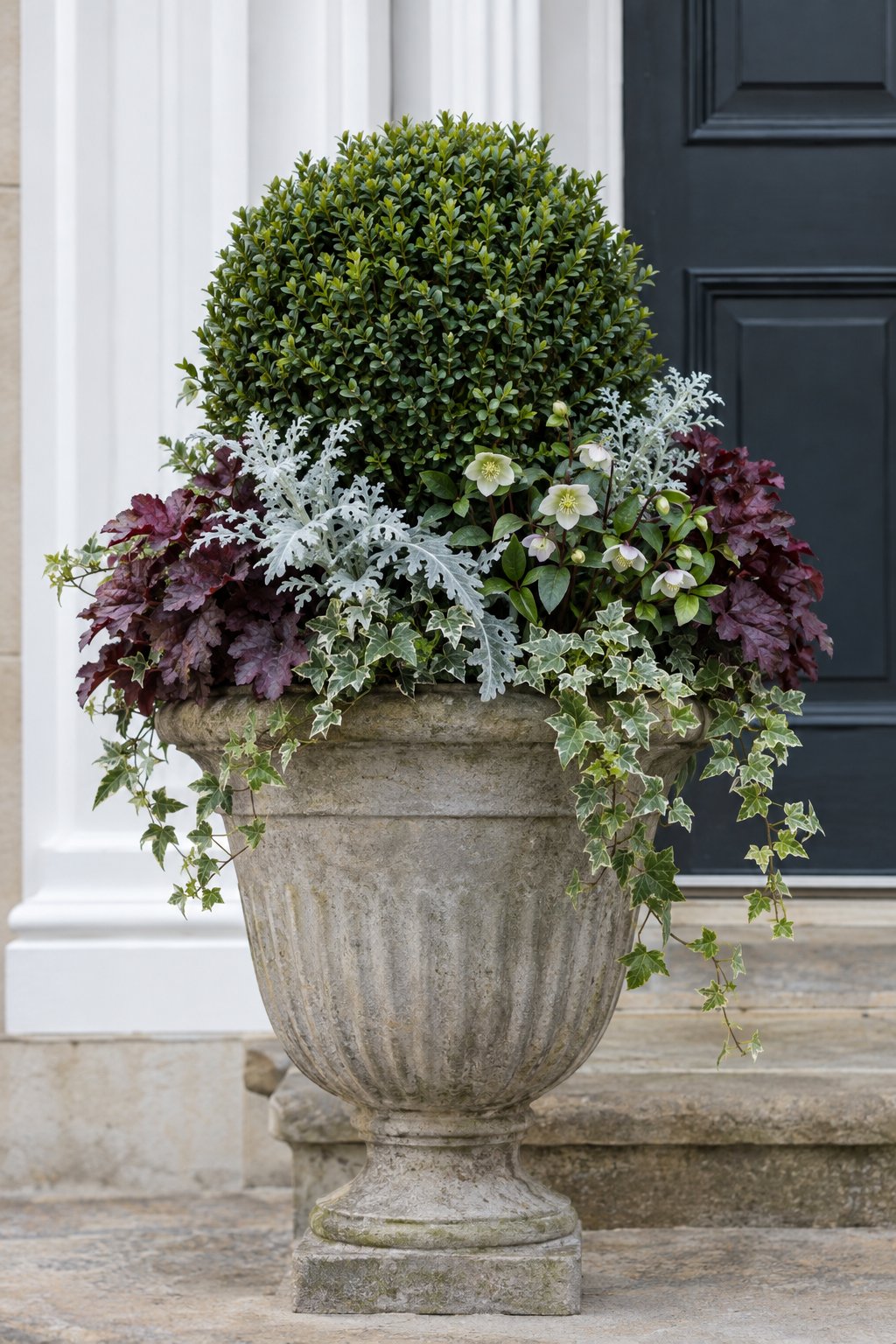
A clipped boxwood sphere provides a strong outline for a formal porch pot. Set it high enough that its lowest branches clear the rim, then fill the surrounding soil with low evergreen foliage, such as heuchera or creeping juniper. The base planting should sit beneath the sphere’s outline.
Boxwood in containers faces winter drying, especially beside reflective walls or on windy steps. Water before the soil freezes if conditions have been dry. A broad pot gives the roots insulation and keeps the rounded top from appearing top-heavy.
Mugo Pine And Ornamental Grass Planter
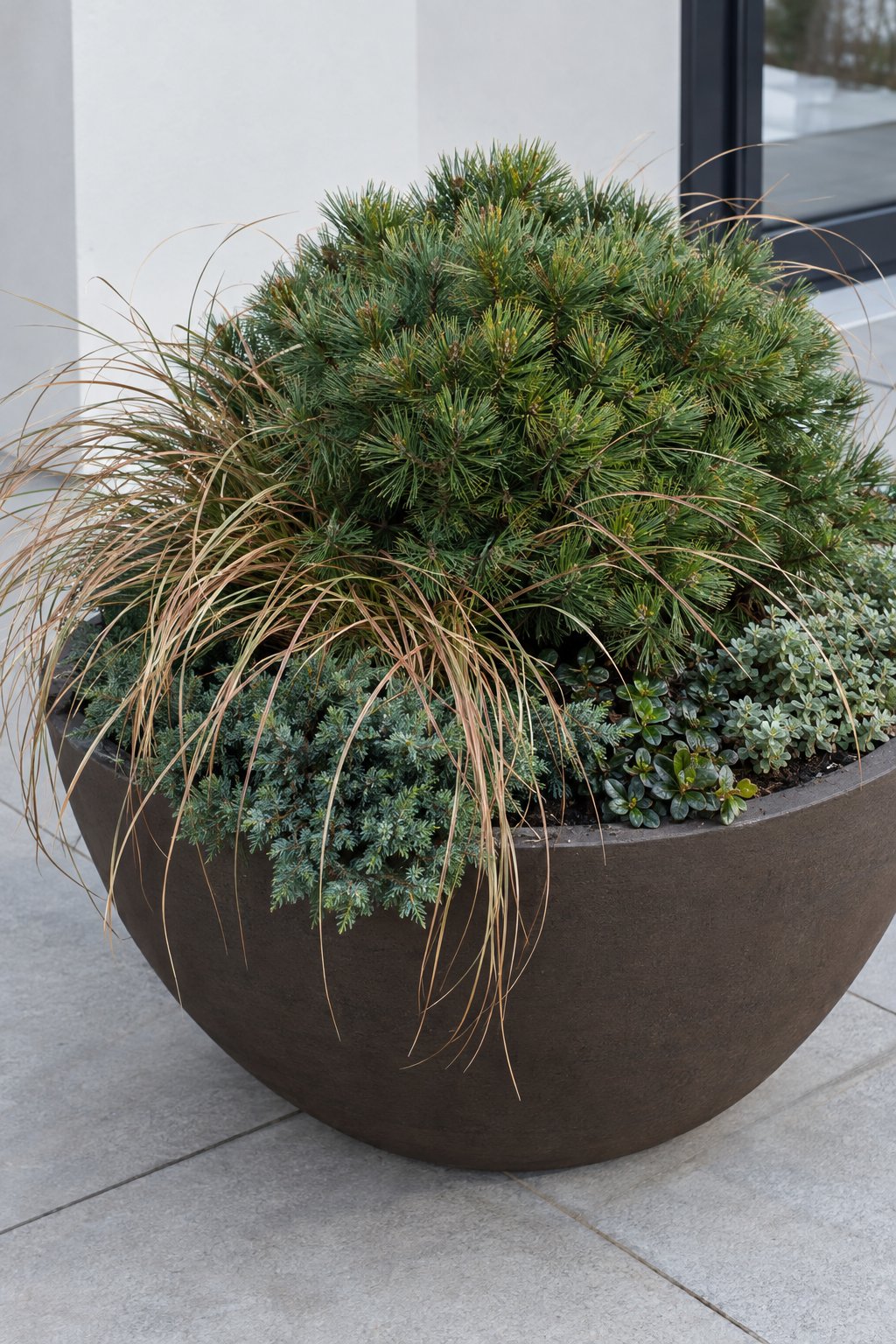
Wind animates the dry seed heads of ornamental grass beside the dense needles of mugo pine. Choose a compact mugo cultivar as the permanent planting and position a small, upright grass off-center. Its arching blades need space beyond the pine’s branch tips.
Grass selection depends on winter climate: a hardy deciduous variety supplies tawny stems, while an evergreen sedge keeps living foliage in milder sites. Leave standing seed heads through winter only when they remain upright. Trim flattened growth before it mats against the pine.
Snow-Dusted Evergreen And Heather Pot
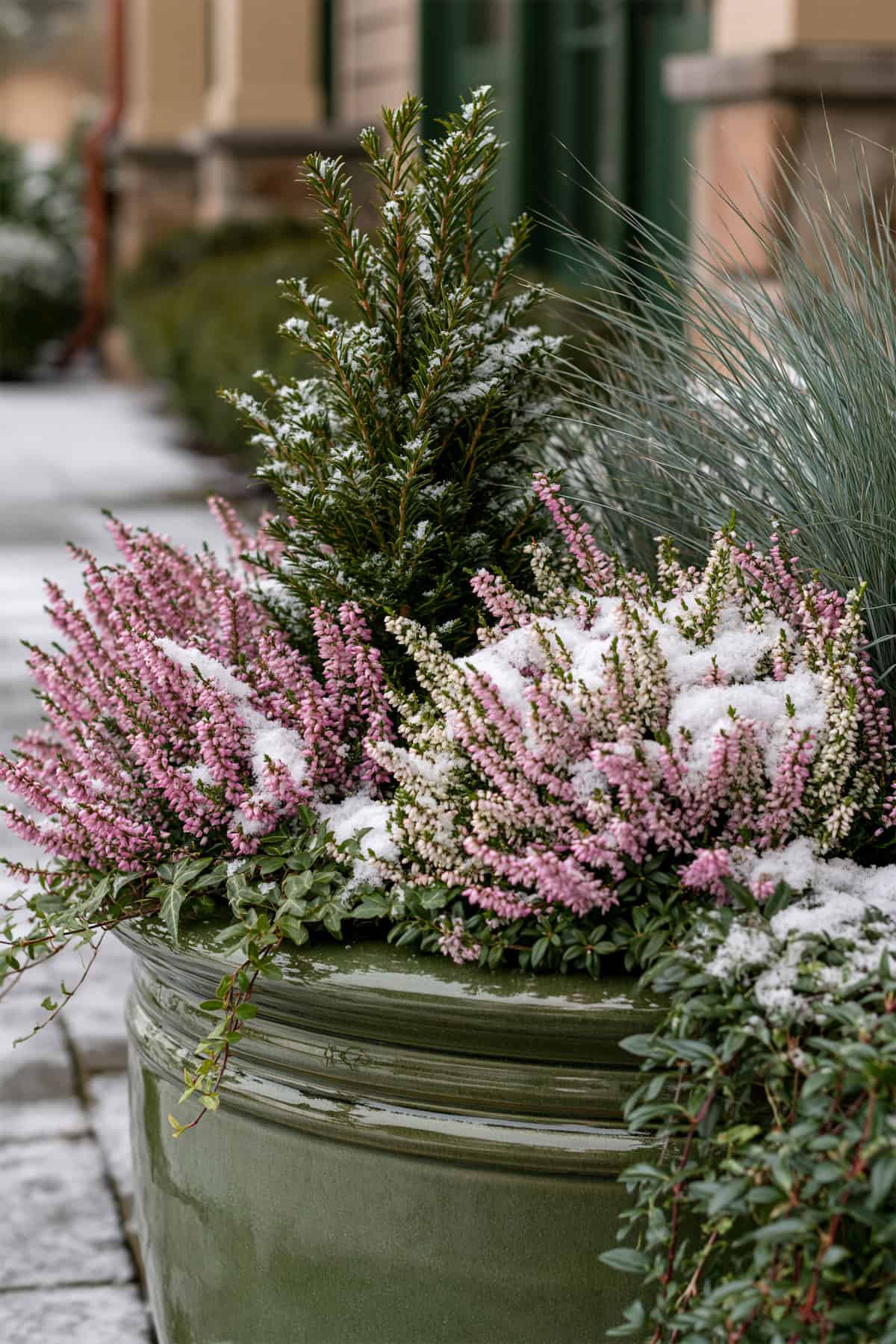
Heather keeps a low pot colorful beneath an evergreen whose branches catch light snowfall. Pair a compact conifer with winter-flowering Erica carnea, placing the heather near the front where its small blooms remain visible. Keep the container in a bright position with free-draining mix.
Flowering heathers differ in soil preferences and cold tolerance, making the plant label worth checking. Snow itself provides brief insulation; saturated soil poses a greater risk to roots. Brush heavy, wet snow from delicate conifer branches if they begin to bend.
Evergreen Sedge And Hellebore Mix
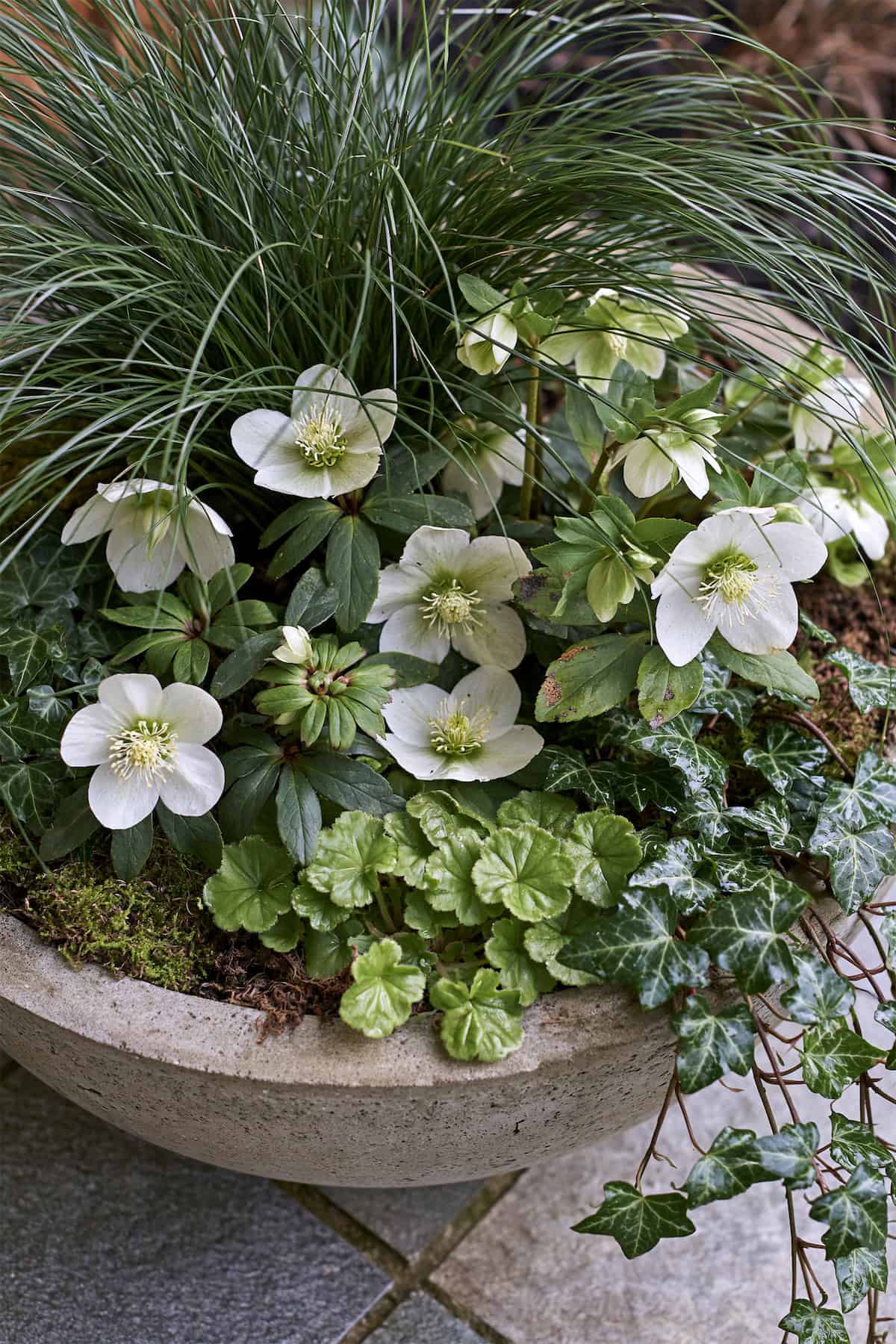
Fine sedge blades frame hellebore blooms without blocking their nodding faces. In a broad, shallow pot, group an evergreen sedge behind one or two hellebores and leave open space near the front rim. The plants share a preference for moisture that drains away promptly.
Select a sedge rated hardy for the local climate, since evergreen varieties vary. Hellebore foliage may look worn by late winter; remove damaged older leaves before flower stems lengthen. That small cut also reveals buds tucked beneath the foliage.
Dwarf Pine With Burgundy And Silver Foliage
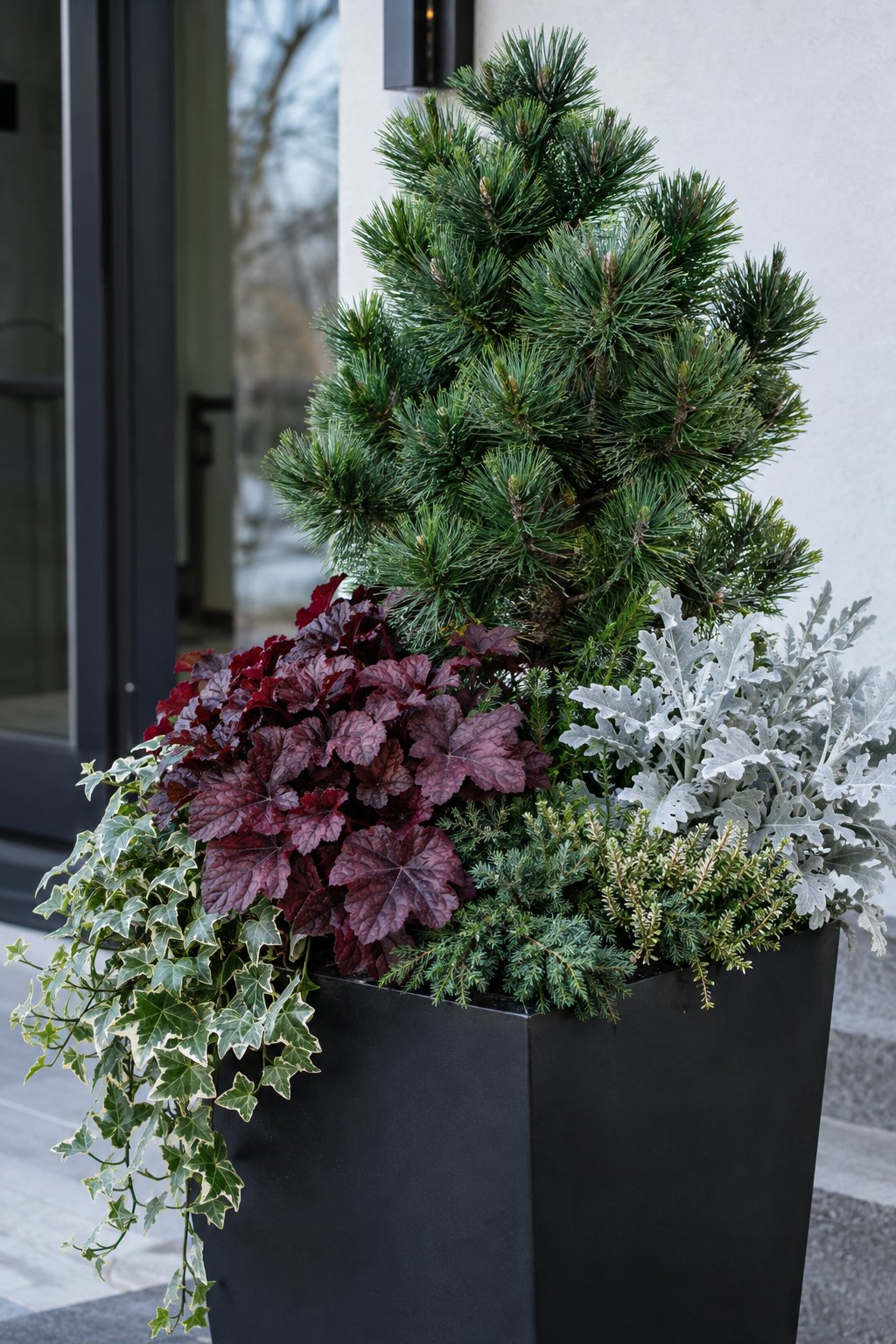
A deep green dwarf pine grounds a planting of burgundy heuchera and silver-leaf heuchera. Keep the pine slightly off-center, with the darker leaves nearest its base and the silver foliage near the rim. Spacing each crown separately prevents fallen pine needles from collecting in the leaf clusters.
Check the heuchera varieties for local hardiness before planting, particularly where pots freeze through. In winter, lift dead leaves from their crowns rather than packing mulch against them. The pine’s shape remains visible above the lower foliage.
Winterberry And White Pine Arrangement
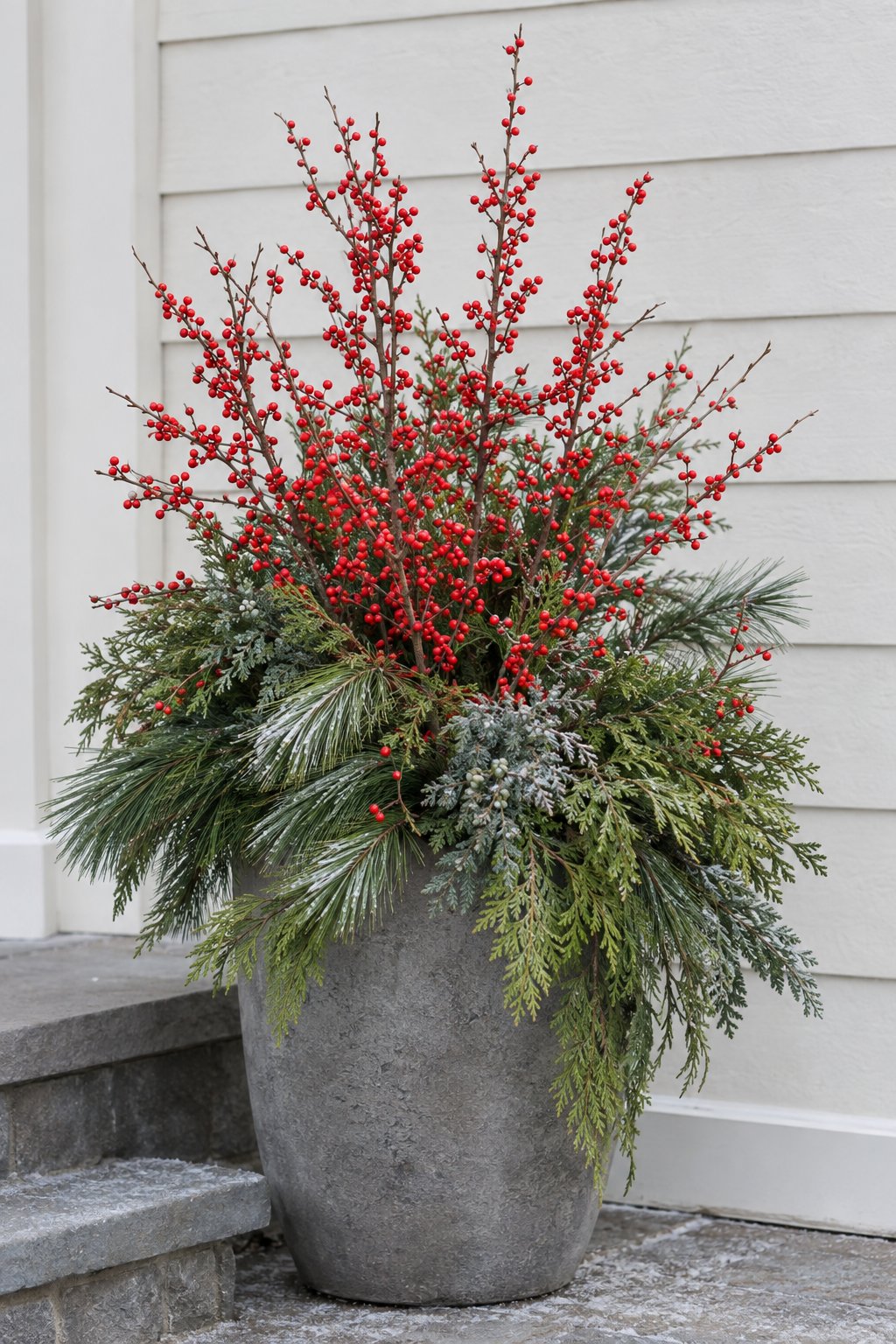
Long white pine needles give cut winterberry stems room to stand out. Fan pine boughs around the rim of a deep container, then insert several berry-laden branches through the center. Their natural forks provide a branching arrangement without added ornaments.
Secure the stems in damp soil or a weighted insert, especially where wind reaches the porch. White pine boughs shed needles as they dry, so keep the arrangement away from door swings and frequently used steps. Fruit-bearing branches may thin as birds visit.
Mini Evergreen Forest Container
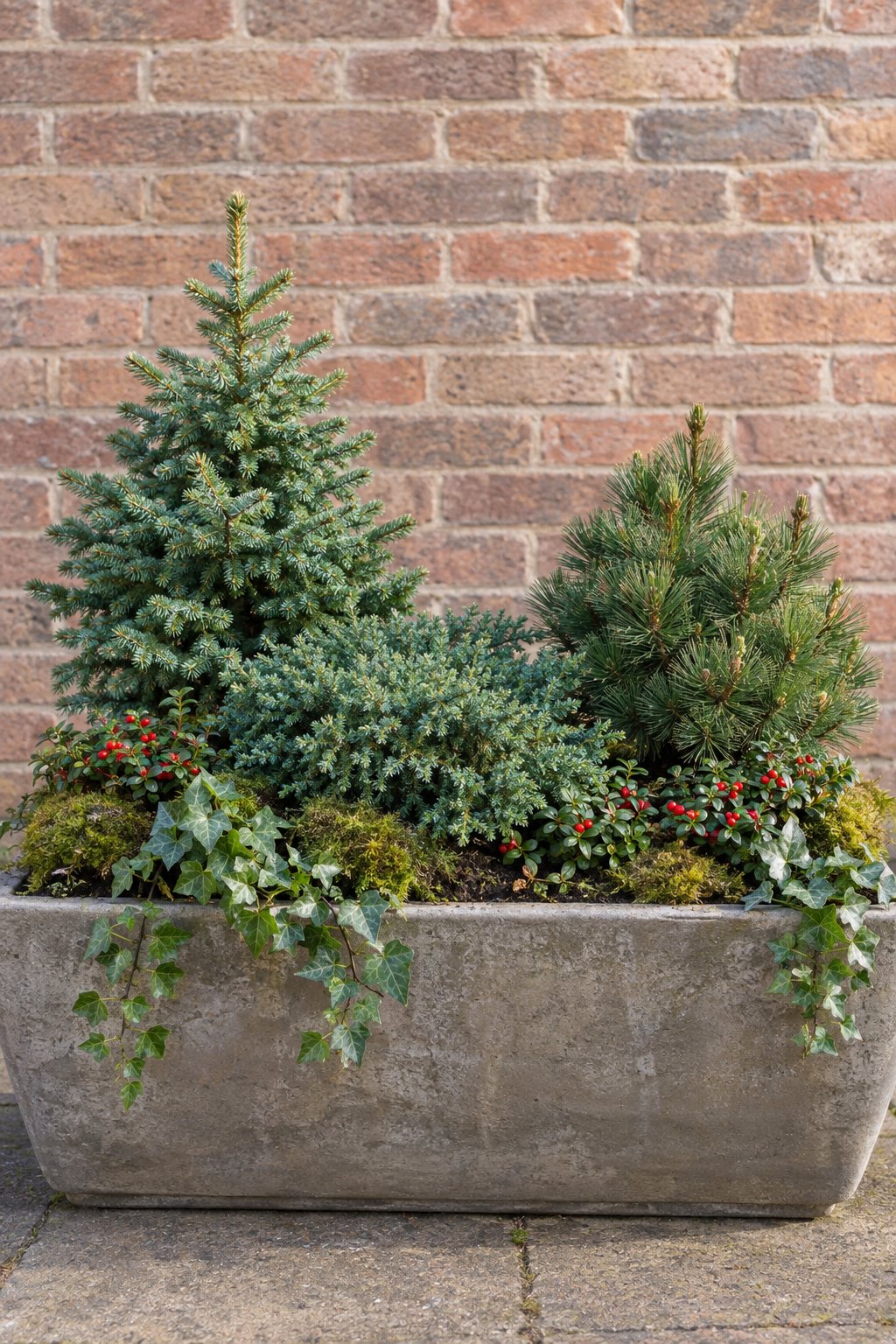
Three small conifers of different heights suggest a woodland planting within one wide container. Give each root ball adequate space, placing the tallest toward the back and leaving gaps that reveal the individual trees. A thin layer of bark mulch covers bare soil without burying the trunks.
Choose slow-growing cultivars with similar light and moisture needs. Their root systems will eventually fill the pot, making this a planting that needs monitoring beyond its first winter. Check moisture beneath the mulch, where the surface may look dry after rain.
Wintergreen And Fern Porch Pot
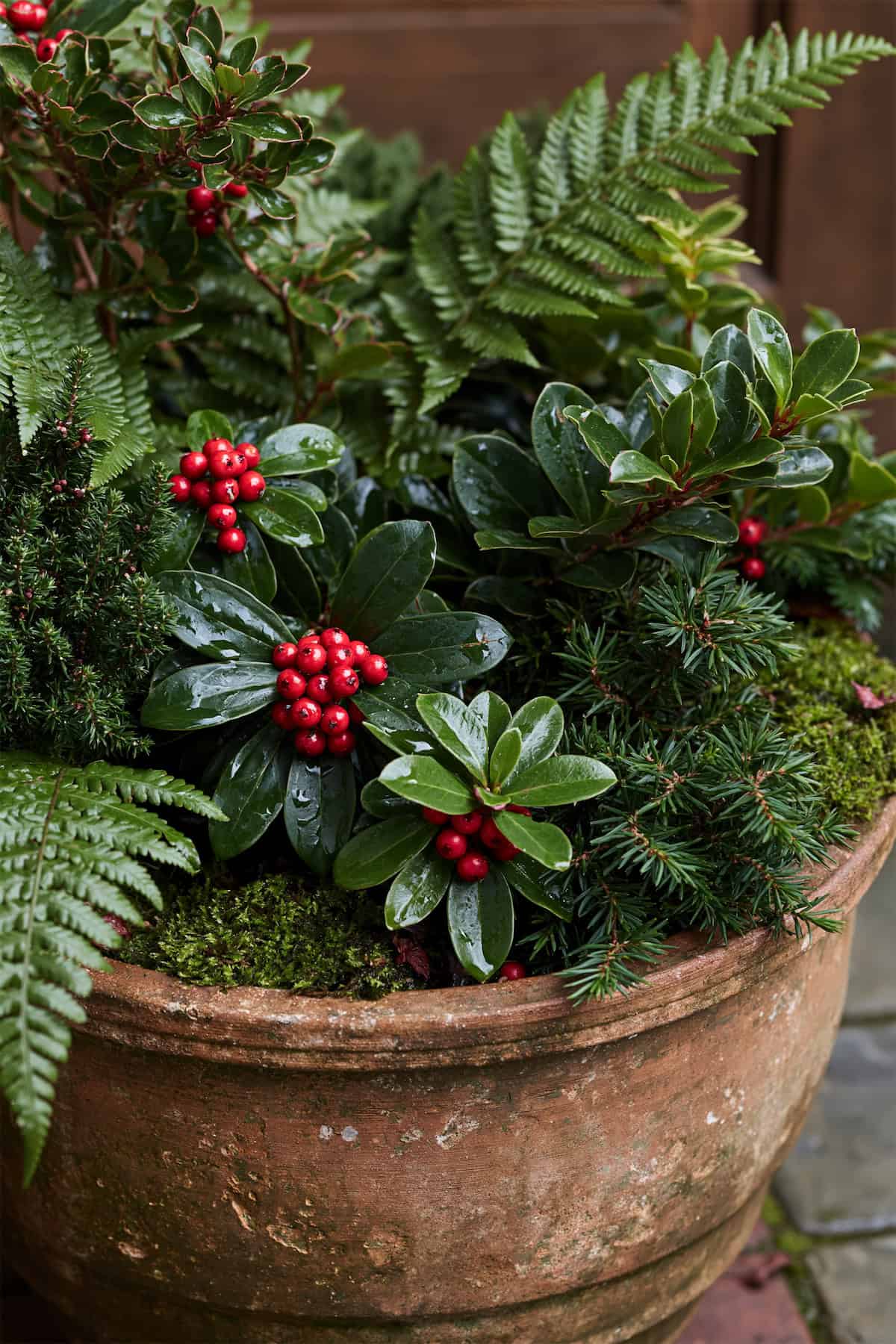
A sheltered, shaded porch gives wintergreen’s glossy leaves and red berries a setting alongside an evergreen fern. Plant wintergreen near the front edge and position a compact hardy fern behind it, allowing its fronds to spread over the pot without covering the berries.
Wintergreen favors acidic soil and steady moisture. Fern hardiness varies by species, and a container exposes roots to colder conditions than garden soil does. Keep the planting out of drying wind and check the soil beneath the fern’s fronds during rain-free weather.
Blue Juniper And White Ornamental Cabbage
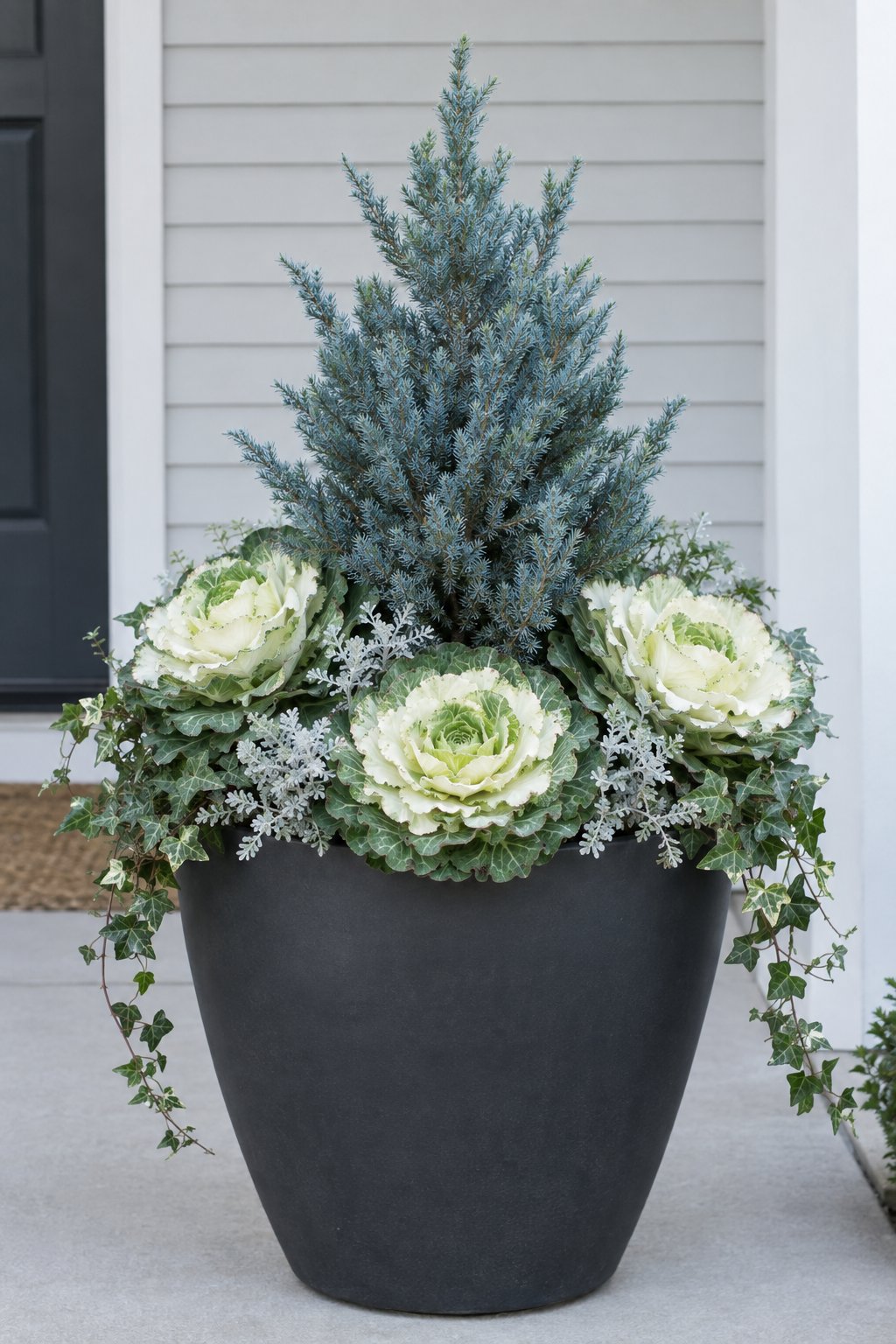
Pale ornamental cabbage echoes the frosty cast of blue juniper without blending into its fine needles. Plant a compact upright juniper toward the back of a wide pot, then place one or two white-centered cabbages where their rosettes show fully from the front.
The cabbage holds its form through cool weather and light frost. After prolonged freezing, outer leaves may turn translucent and collapse; remove the plant before decay reaches the juniper’s base. The juniper remains rooted for another season in a well-drained container.
Tall Arborvitae With Layered Base Planting
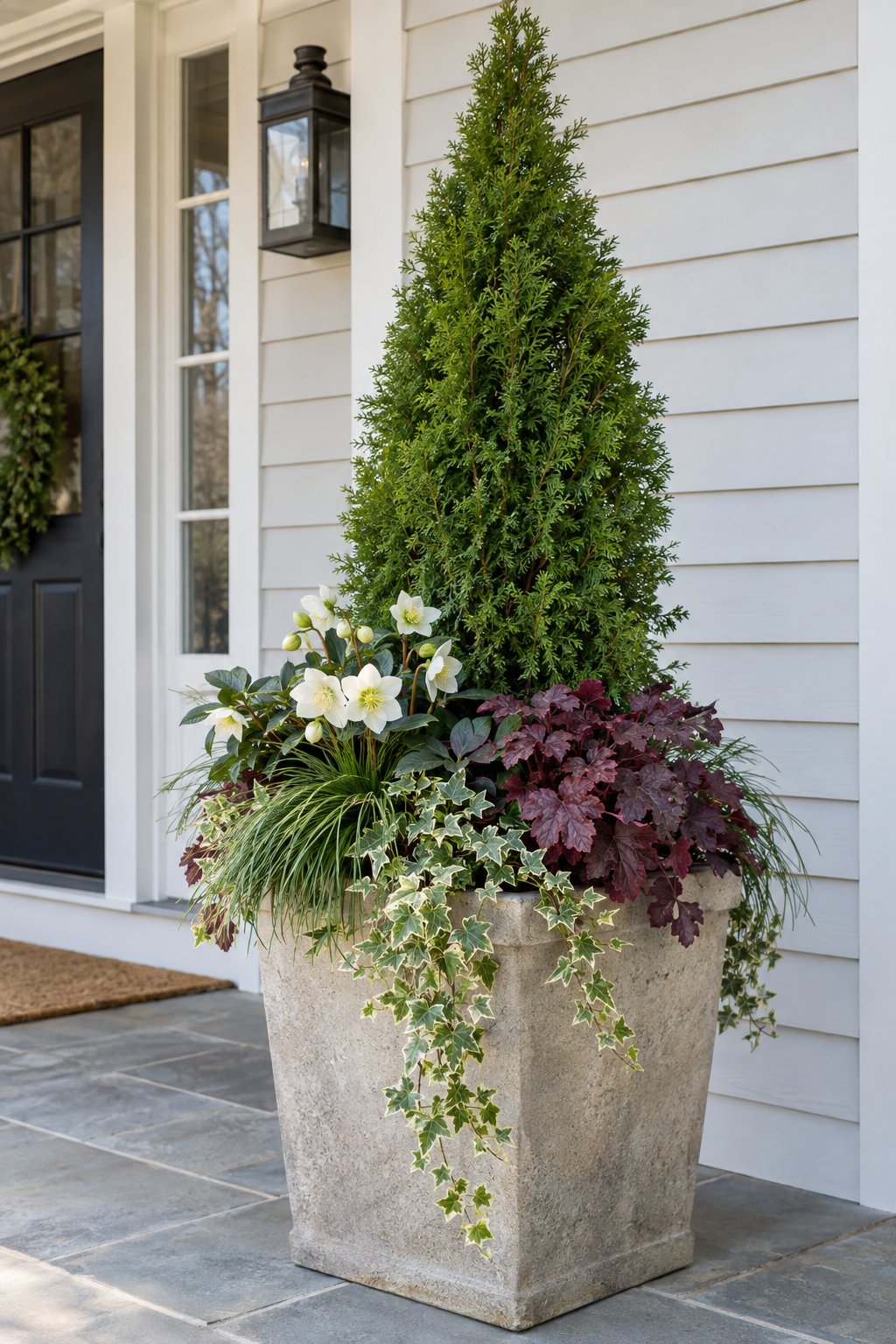
A tall arborvitae gives a large doorway pot the height of a small tree without a broad canopy. Anchor it in a deep, stable container, then plant low heuchera and trailing ivy around the exposed soil. Keep both below the arborvitae’s lowest branches.
The tree’s height makes wind stability a practical concern. A heavy pot and a position near a sheltered wall reduce the chance of tipping. Arborvitae also needs moisture through winter dry spells, particularly when its evergreen foliage faces sun and wind.
Bare Branches With Ornamental Kale And Ivy
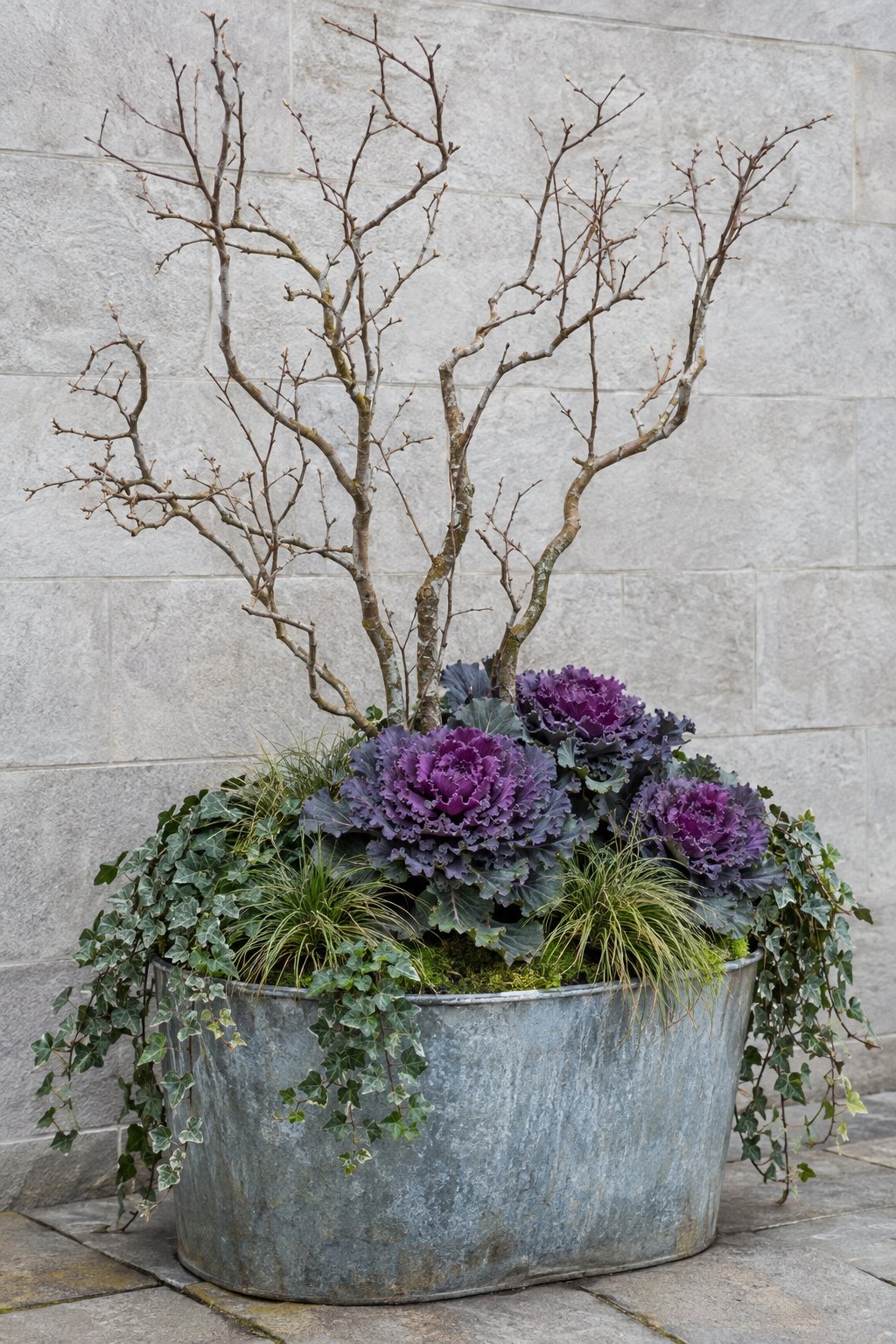
Thin, leafless branches draw the eye upward from a dense base of kale rosettes. Press cut branches into the center of a wide pot, arrange ornamental kale around them, and let ivy cross the rim in loose trails. The open stems keep the arrangement from looking crowded.
Choose branches with interesting forks and trim any tips that interfere with a doorway. Kale tolerates cold weather but declines after severe freezes; damaged plants should be removed promptly. Ivy continues to cover the rim where it remains winter-hardy.
Hinoki Cypress With Moss And Hellebores
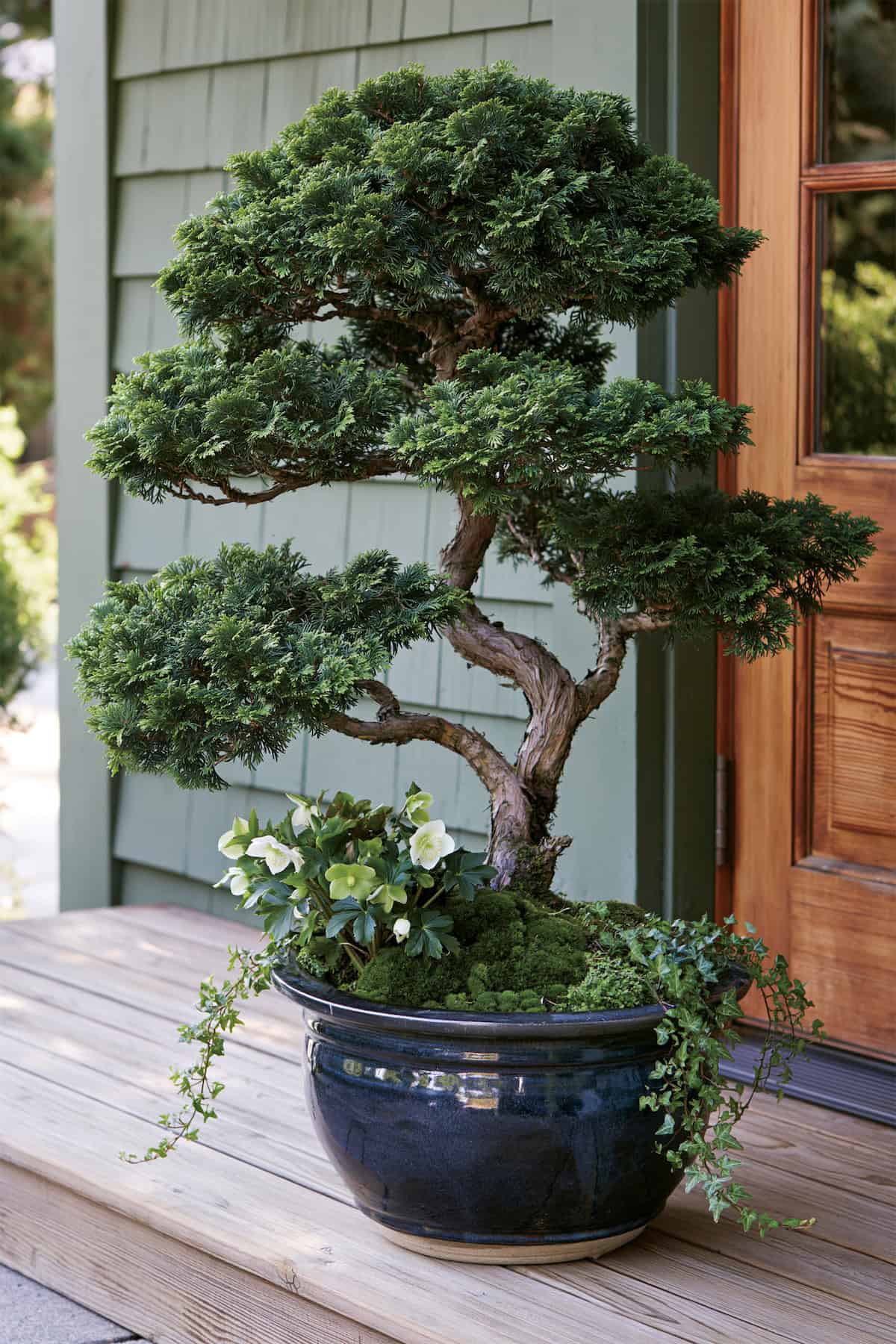
The layered sprays of a compact Hinoki cypress deserve clear space around them. Set one toward the back of a broad planter, with hellebores near the front and a thin covering of moss over exposed soil. Keep moss clear of the plant crowns and the cypress trunk.
Hinoki cultivars vary in mature size, so a slow-growing selection belongs in a container. Hellebores favor a sheltered position, especially when flower buds emerge during late-winter cold snaps. Lift the moss occasionally to check soil moisture beneath it.
Red-Twig Dogwood And White Hellebore Pot
White hellebore blooms stand out beneath upright red dogwood stems, particularly against a dark pot. Use cut dogwood branches behind a living hellebore rather than planting a full-size shrub beside its roots. A handful of evenly spaced stems leaves the flower stalks visible.
Set the hellebore crown level with the soil and insert branches carefully away from its root ball. Flowering depends on the variety and local winter temperatures. When the cut stems dry or discolor, they lift out without disturbing the established plant.
Ornamental Cabbage And Blue Fescue Winter Bowl
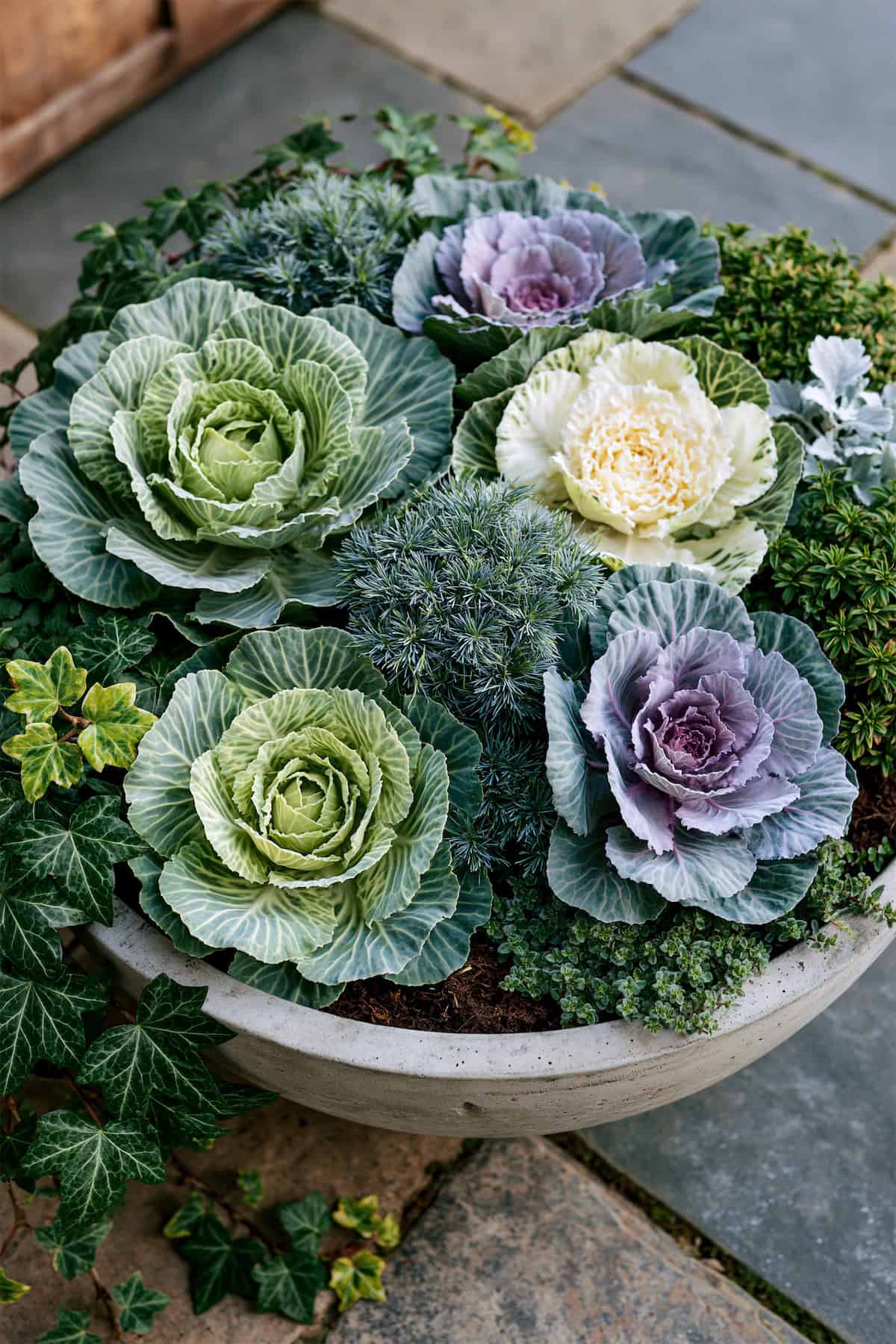
A low bowl lets ornamental cabbage’s broad rosette sit among the narrow blades of blue fescue. Place the cabbage slightly off-center and group fescue in small clumps around it, leaving enough bare space to show each plant’s shape. Their blue-gray coloring is particularly clear in a dark container.
Both need drainage, making an outdoor bowl with open holes essential. Blue fescue dislikes persistently wet winter soil, and ornamental cabbage declines after sustained hard freezes. Remove damaged cabbage leaves as they appear rather than leaving them against the grass.
Dwarf Spruce With Pinecone Mulch
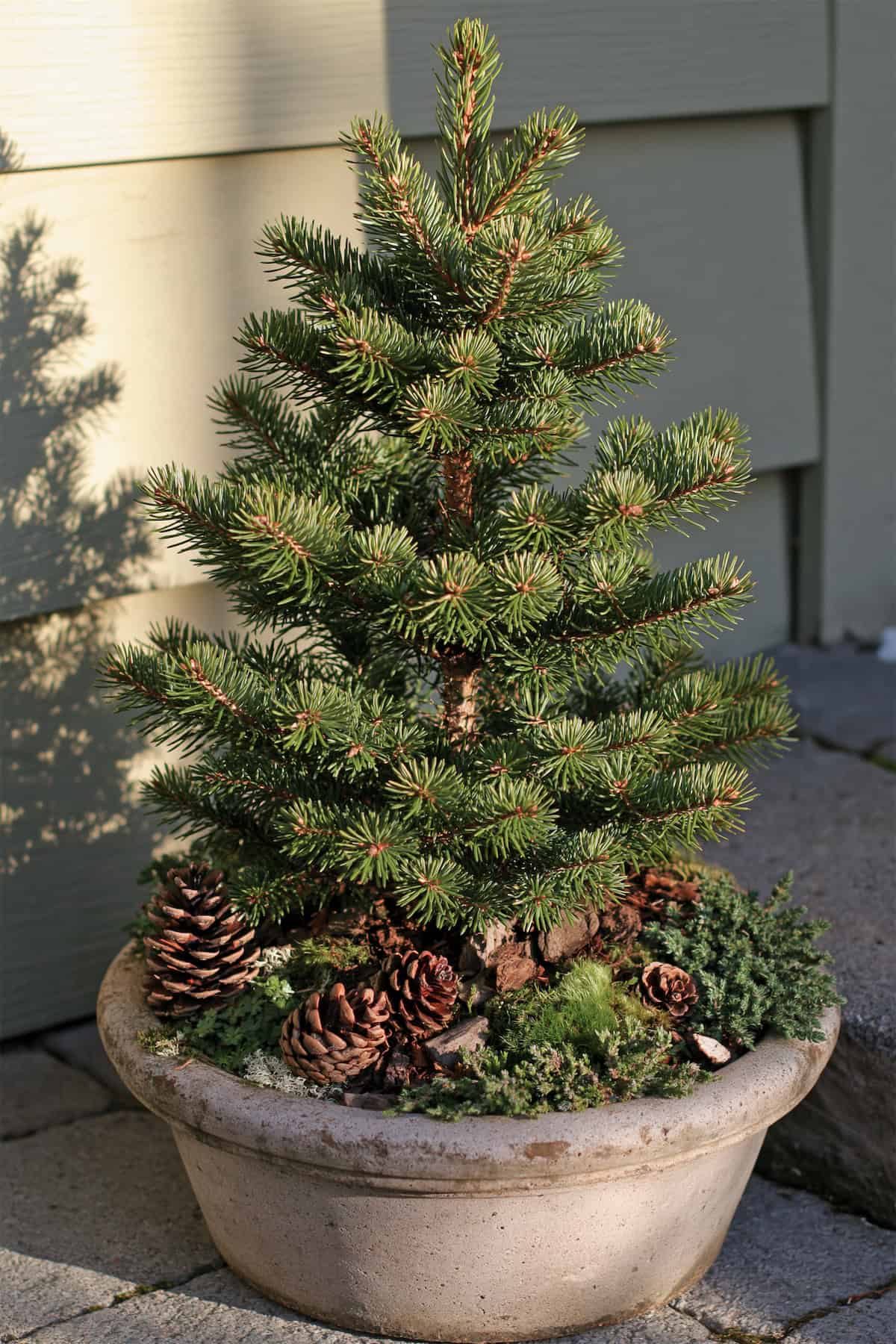
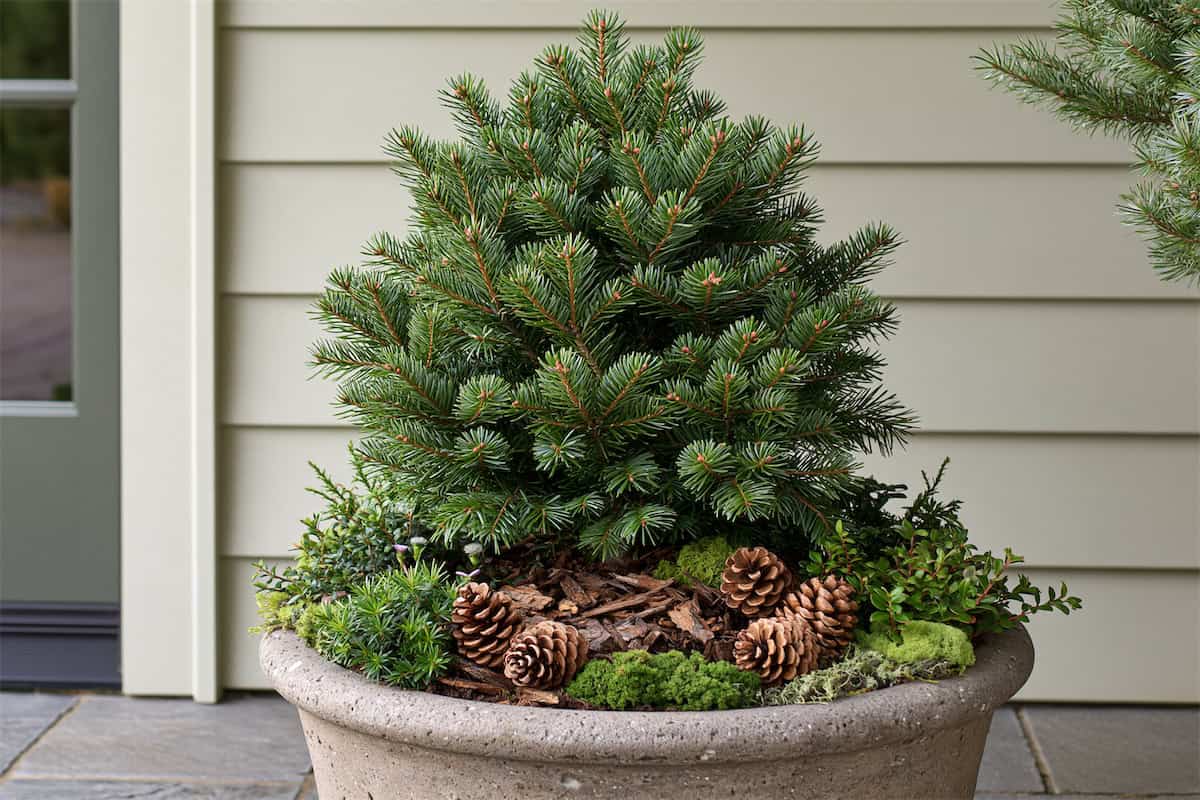
Pinecones give a single dwarf spruce a defined base in an otherwise spare planter. Plant the spruce centrally in a substantial pot, then place small, clean cones across the exposed soil. Leave a gap around the trunk and avoid a deep pile that traps moisture against it.
The cones are a decorative surface layer, not a substitute for drainage or adequate soil depth. Check the potting mix beneath them during dry weather. In exposed locations, a light application of bark mulch below the cones helps hold the top layer in place.
Heather And Small Conifer Cluster
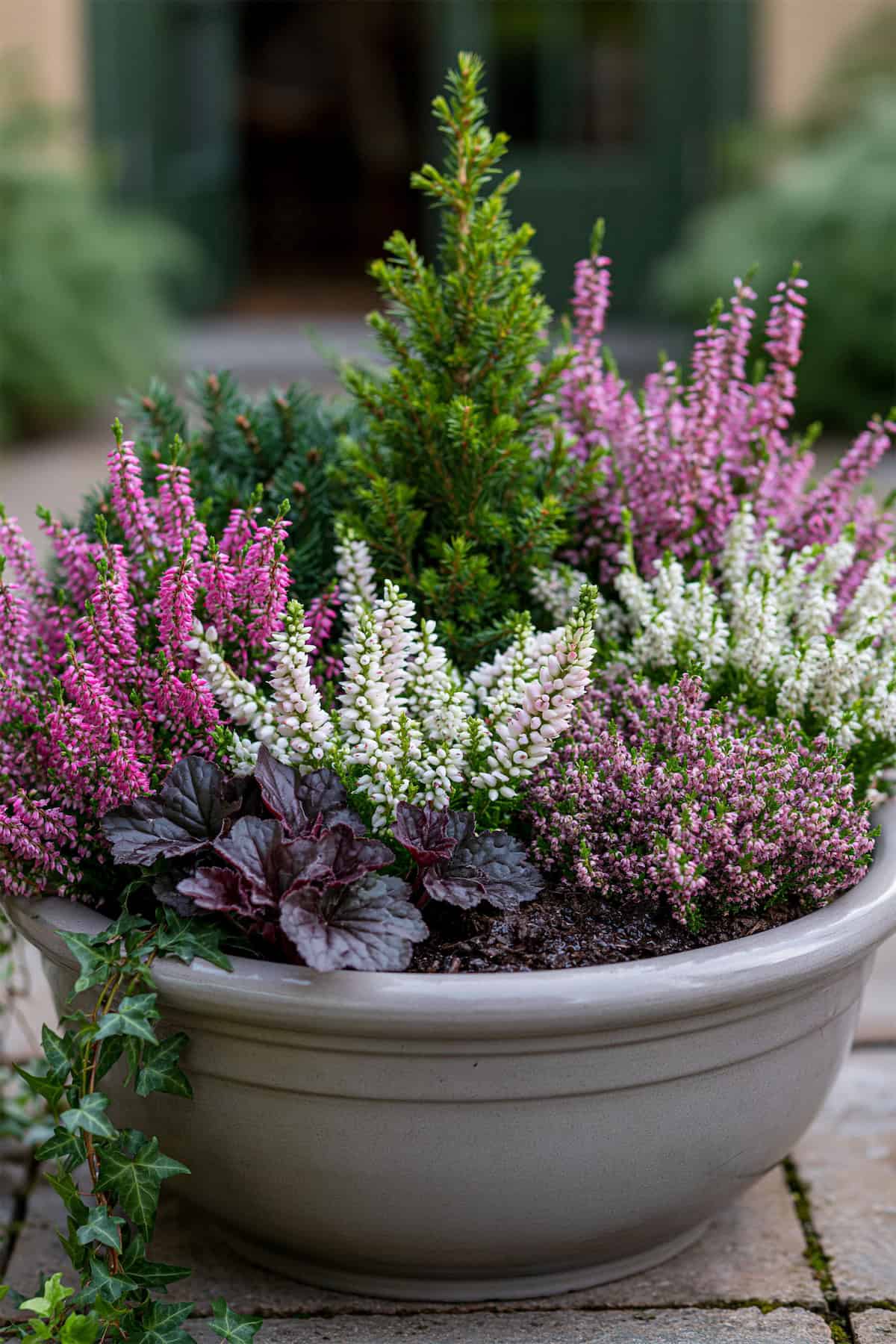
Several low heather plants turn a small conifer into the center of a compact flowering group. Choose a winter-blooming heather suited to the site, then arrange it around a slow-growing conifer with enough space for air circulation. A wide planter shows the cluster without crowding the roots.
Heather needs sharp drainage, particularly through repeated winter rain. Check its soil requirements against the selected conifer before combining them. As blooms fade, lightly trim the flowering stems according to the plant’s growth habit, keeping cuts out of old bare wood.
Yellow-Twig Dogwood And Blue Spruce Container
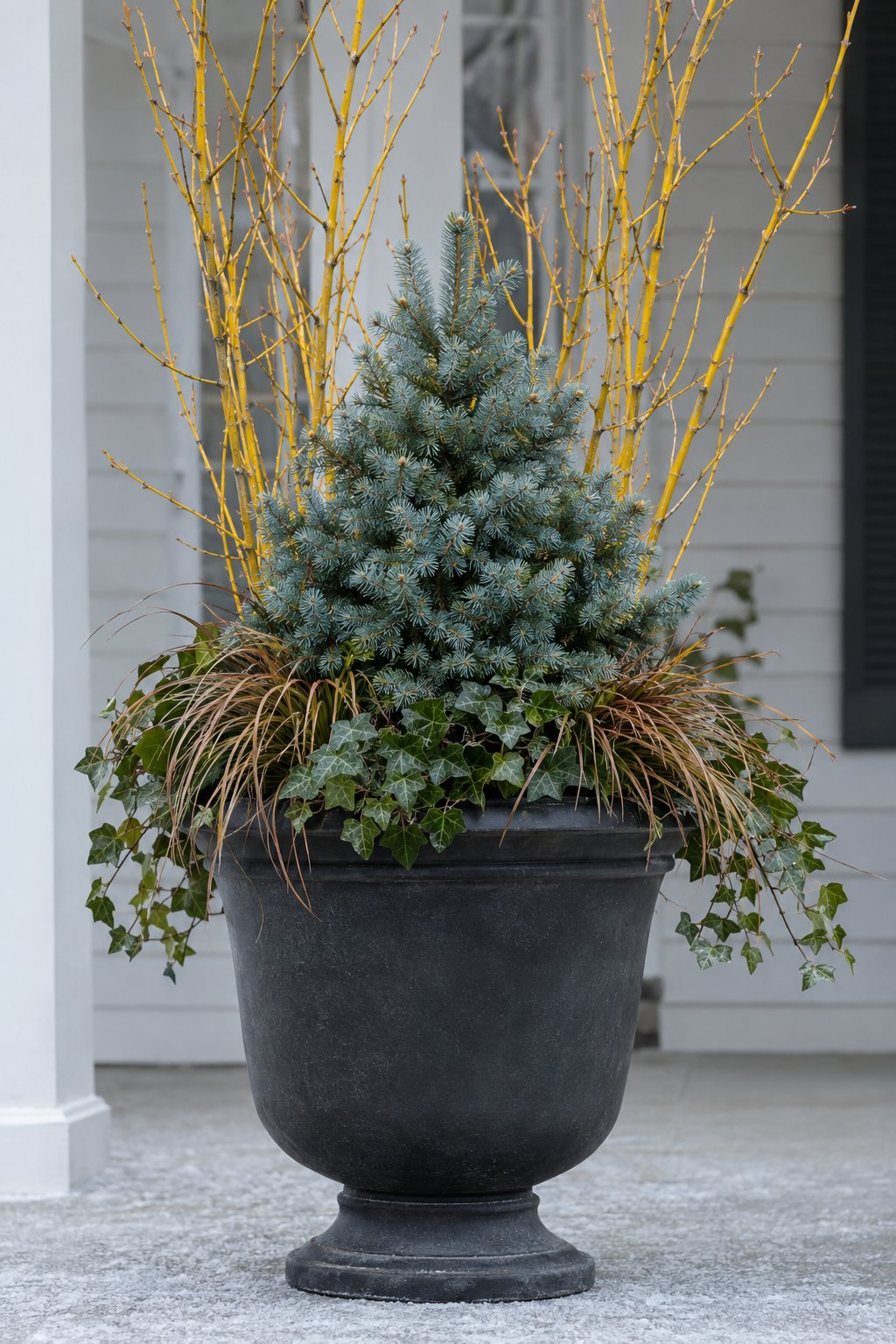
Yellow dogwood stems catch weak winter light above the cool needles of blue spruce. For a rooted planting, choose a compact spruce and insert cut yellow-twig dogwood branches behind its crown, keeping them clear of the leading shoot. The yellow stems remain distinct even under gray skies.
A deep pot provides room for the spruce’s roots and enough weight to hold the tall branches steady. Dogwood stems collected after leaf fall have the clearest color. Replace them when their bark begins to dull, leaving the spruce undisturbed.
Mixed Evergreen Trough With Winter Berries
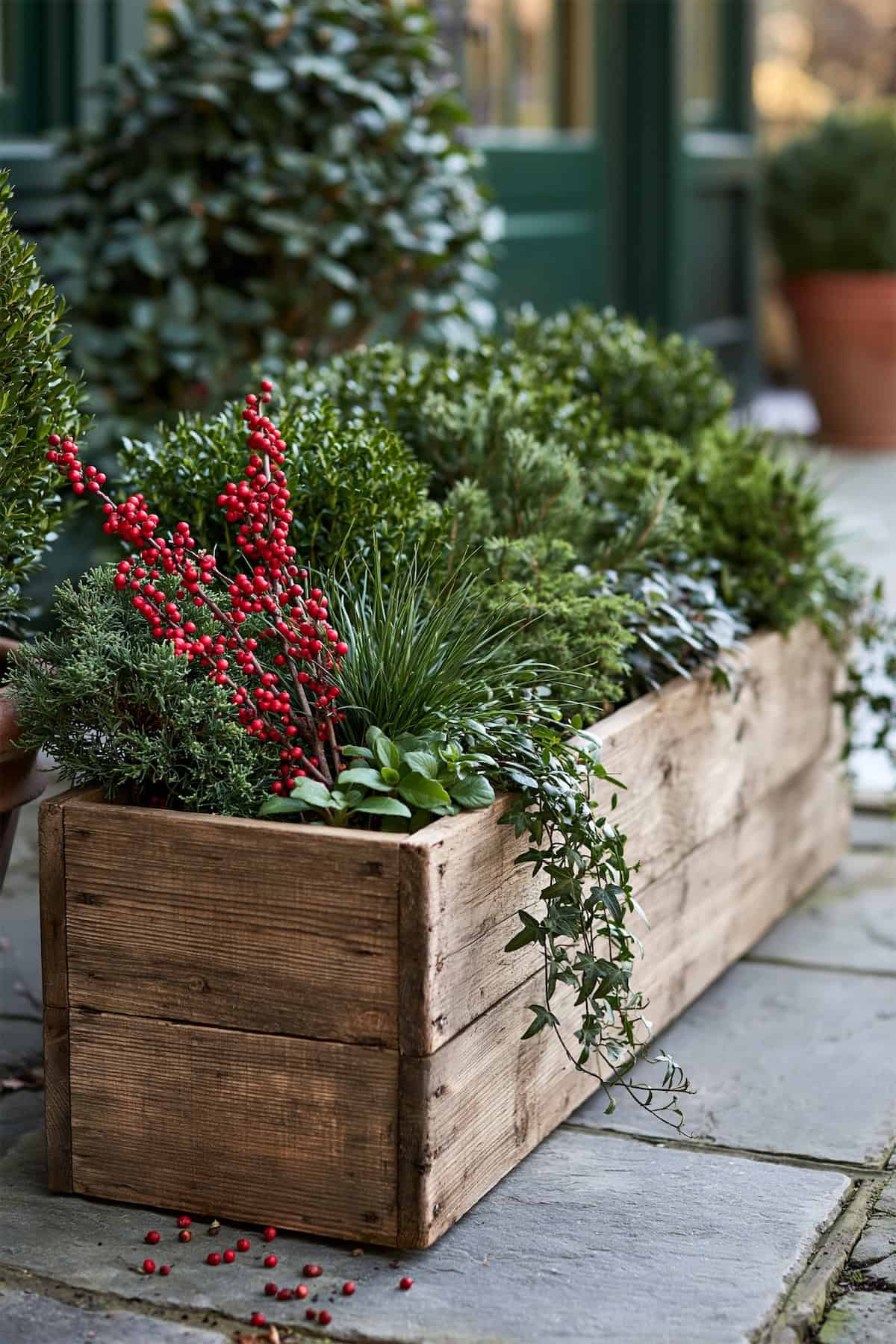
A long trough gives several evergreens room to form a continuous planting along a railing or porch wall. Space compact juniper and dwarf conifers along its length, then tuck cut winterberry stems into open gaps. Keep the berries in small groups where their branching forms remain visible.
Troughs expose a broad soil surface to winter wind. Check moisture along the entire container, since sheltered ends and exposed ends dry at different rates. Use a frost-resistant trough with multiple drainage holes so water does not collect around the roots.
Black Planter With Silver And Evergreen Foliage
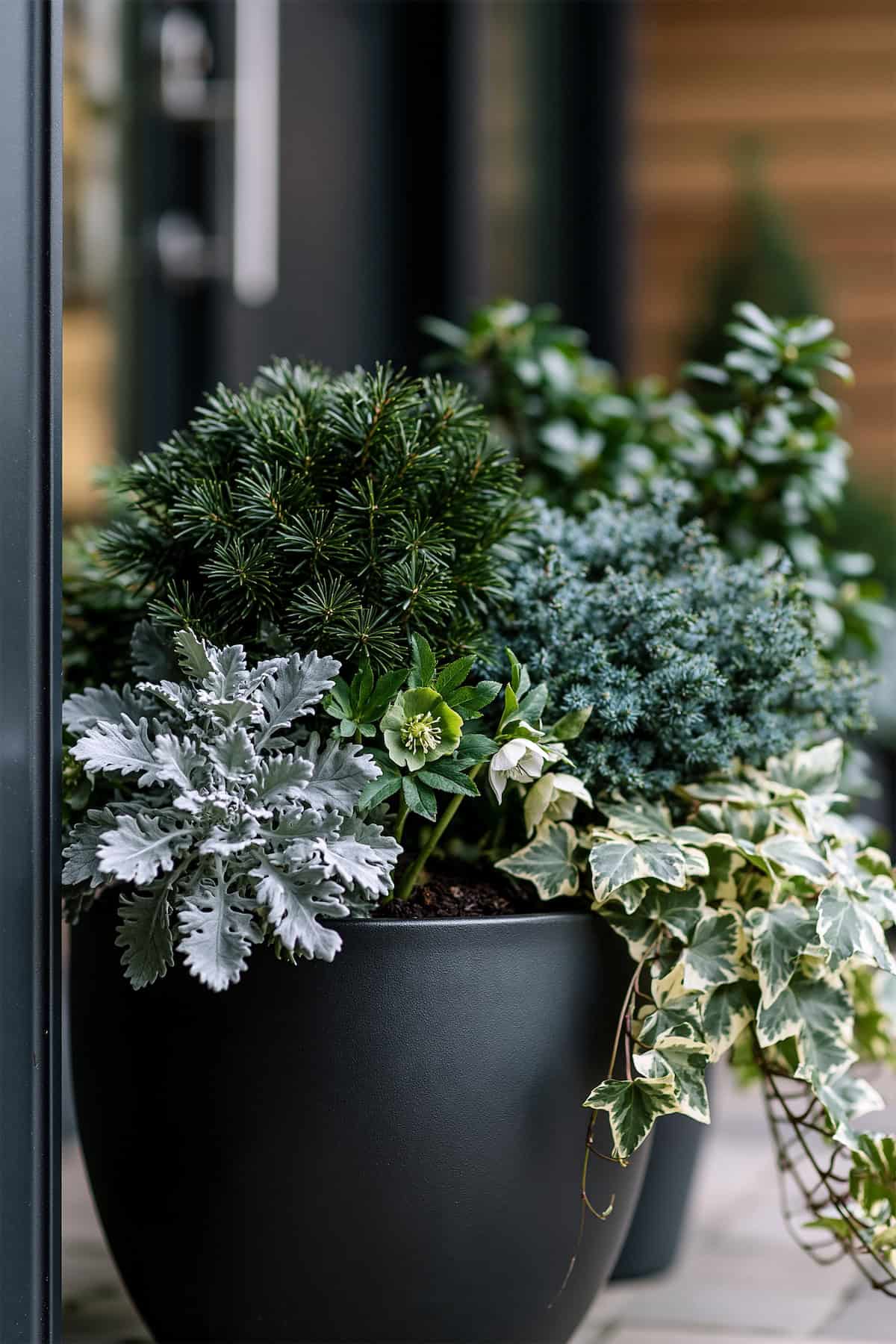
Matte black sets off silver-leaf heuchera and deep green evergreen foliage with striking clarity. Place a compact conifer toward the rear of the planter and let the heuchera occupy the front, where its leaves show against the dark rim. Keep the arrangement loose enough for each plant’s outline to remain visible.
A black container in winter sun may warm during the day and cool rapidly after sunset. Position it away from the harshest afternoon exposure in regions with frequent freeze-thaw cycles. Clear fallen evergreen needles from the heuchera’s crown after windy days.