
Most perennials flower for two or three weeks and then spend the rest of the year as greenery.
A smaller group breaks that pattern and blooms for two months or more, and several of them carry on through summer and into fall with a little deadheading.
Bloom windows, heights and sun needs sit next to every one of these 22 picks.
Table of Contents
- Long-Blooming Perennials
- Coreopsis (Coreopsis verticillata, Coreopsis grandiflora)
- Black-Eyed Susan (Rudbeckia fulgida ‘Goldsturm’)
- Shasta Daisy (Leucanthemum x superbum)
- Coneflower (Echinacea purpurea)
- Catmint (Nepeta faassenii)
- Salvia (Salvia nemorosa, Salvia farinacea)
- Russian Sage (Perovskia atriplicifolia)
- Gaillardia (Blanket Flower)
- Geranium (Geranium Rozanne)
- Daylily (Hemerocallis hybrids)
- Garden Phlox (Phlox paniculata)
- Yarrow (Achillea millefolium)
- Lavender (Lavandula angustifolia)
- Bee Balm (Monarda didyma)
- Lanceleaf Coreopsis (Coreopsis lanceolata)
- Scabiosa (Pincushion Flower)
- Heliopsis (Heliopsis helianthoides)
- Veronica (Veronica spicata)
- Gaura (Oenothera lindheimeri)
- Sedum ‘Autumn Joy’ (Hylotelephium spectabile)
- Japanese Anemone (Anemone hupehensis)
- Balloon Flower (Platycodon grandiflorus)
Long-Blooming Perennials
These perennials produce color for months, which makes it far easier to fill a garden with flowers through spring, summer and autumn.
Coreopsis (Coreopsis verticillata, Coreopsis grandiflora)
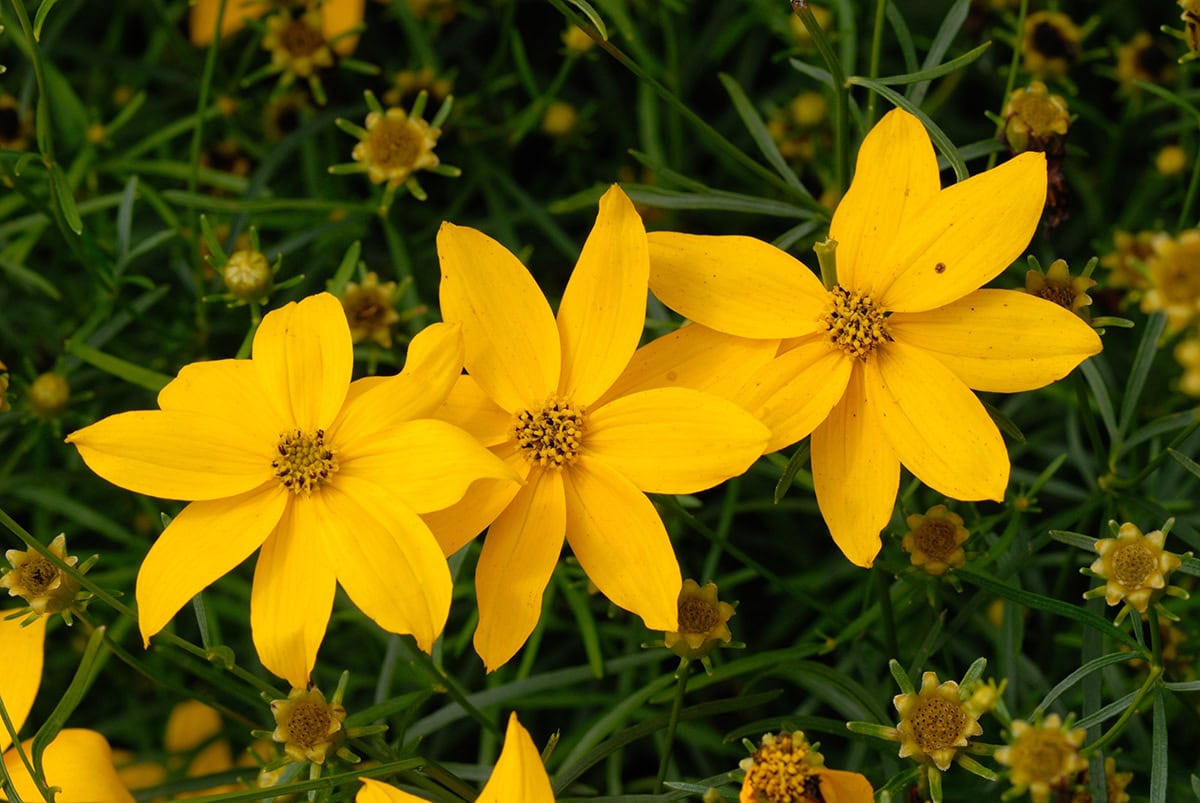
Coreopsis flowers for a long stretch, from late spring until frost in many gardens, with yellow, daisy-like blooms. It thrives in full sun and shrugs off dry soil.
Deadheading prompts more flowers, though upkeep is minimal overall. Plants reach 18 to 24 inches, handle heat well and rarely attract deer, which makes them a good choice for open spots.
Black-Eyed Susan (Rudbeckia fulgida ‘Goldsturm’)
A dark cone ringed in golden petals makes black-eyed Susan a garden classic. Blooms last from midsummer into early fall, and pollinators flock to them.
‘Goldsturm’ grows about 2 feet tall in full sun and shrugs off most pests and diseases. It looks bold in borders or large groups, and the seedheads hold winter interest after the petals drop.
Shasta Daisy (Leucanthemum x superbum)

White petals around a yellow center lend Shasta daisy its cheerful look, and the blooms run from early summer into early fall.
Plants reach 2 to 3 feet in full sun and well-drained soil. Snip off spent blooms to extend the season. Shasta daisies are a cutting-garden staple and mix easily with other perennials.
Coneflower (Echinacea purpurea)
Big, pinkish-purple daisies cover coneflower from early summer into fall, and bees and butterflies visit constantly.
Once established, Echinacea handles drought, thrives in sun and tolerates light shade. Leave the seedheads for goldfinches in fall. The upright habit fits formal and relaxed plantings alike.
Catmint (Nepeta faassenii)

Soft purple-blue spikes cover catmint from late spring into summer above aromatic gray-green leaves.
Drought-tolerant and rarely bothered by pests or deer, catmint grows in almost any soil. Shear it by half after the first flush for a second round of blooms. It makes a beautiful edging plant in cottage gardens.
Salvia (Salvia nemorosa, Salvia farinacea)
Upright spikes in blue, purple or white make salvia an eye-catcher from late spring into late summer, and hummingbirds visit regularly.
Full sun is essential, and the plants handle heat and dry spells. Most varieties reach 18 to 30 inches. Trim spent stems for repeat flowering. Salvia nemorosa is hardy to zone 4, while Salvia farinacea survives winter only in zones 8 to 10 and grows as an annual elsewhere.
Russian Sage (Perovskia atriplicifolia)
Airy lavender-blue flowers over silvery, fragrant leaves lend Russian sage a soft, hazy look from midsummer into fall. Botanists now classify it as Salvia yangii.
Full sun and well-drained soil are a must. Russian sage thrives in hot, dry spots and reaches 3 to 5 feet tall and wide, which makes it a good choice for borders or a loose, informal hedge.
Gaillardia (Blanket Flower)

Bold red-and-yellow daisies on gaillardia appear from late spring into fall above gray-green leaves, and they dry well for arrangements.
Full sun and sandy or rocky soil are best, and established plants need little care. Deadhead for a longer show. The compact habit fits tight spaces.
Geranium (Geranium Rozanne)
‘Rozanne’ produces violet-blue blooms from early summer into fall and has few pest problems. The plant spreads quickly and covers ground fast.
It grows in full sun or partial shade, in moist, well-drained soil, and tolerates some drought. That long bloom season sets it apart from other hardy geraniums. Plant it along borders or in partly shaded corners.
Daylily (Hemerocallis hybrids)

Trumpet-shaped flowers in reds, yellows, oranges and pinks open on sturdy daylily stems. Each flower lasts a day, though reblooming hybrids such as ‘Stella de Oro’ flower for months.
Daylilies grow reliably in sun or light shade and tolerate most soils. Deadheading tidies the plant and is optional. Mass them along paths or in large drifts for easy impact.
Garden Phlox (Phlox paniculata)
Tall stems topped with fragrant pink, white or purple clusters make garden phlox a midsummer favorite, and the show runs into early fall. Pollinators visit constantly.
Full sun is best, with a bit of afternoon shade in hot climates. Moist, well-drained soil and mildew-resistant cultivars such as ‘David’ prevent most trouble. Phlox adds height at the back of a border.
Yarrow (Achillea millefolium)

Flat clusters of yellow, red or pink flowers appear on yarrow in early summer and continue into fall over ferny, aromatic foliage.
Dry, poor soil and heat are no problem, and established plants need only occasional water. Some types spread aggressively, so watch them in small beds. Yarrow adds structure to perennial mixes.
Lavender (Lavandula angustifolia)
Purple-blue spikes over fragrant, silvery leaves make lavender a midsummer highlight, and many plants rebloom into fall after a light trim. Pollinators love the scent as much as people do.
Full sun and sandy, well-drained soil are key, since wet roots kill lavender while drought barely bothers it. Plants reach 1 to 2 feet. Prune after flowering for shape, and use lavender for edging, herb gardens or drying.
Bee Balm (Monarda didyma)
Red, pink or purple flower clusters on bee balm draw hummingbirds and butterflies throughout its long summer bloom.
It grows in full sun or partial shade and does best in rich, moist soil. In humid regions, choose mildew-resistant cultivars such as ‘Jacob Cline’. Bee balm fits the back of a border or a wildflower mix.
Lanceleaf Coreopsis (Coreopsis lanceolata)

Lanceleaf coreopsis, a separate species from the threadleaf and large-flowered types above, has bright yellow, daisy-like blooms from late spring through summer and forms neat, dense mounds.
Sun produces the most flowers, and the plant adapts to almost any soil. Deadhead regularly for more blooms. It self-seeds freely and spreads aggressively in some regions, so check local guidance before planting.
Scabiosa (Pincushion Flower)
Lavender-blue or pink pincushion flowers bloom on scabiosa for months over a tidy mound of leaves. Blooms begin in late spring and continue until frost in many gardens.
Full sun and good drainage are best, and average soil is fine. Deadhead for a fresh look and more blooms. ‘Butterfly Blue’ is a popular, long-flowering cultivar for paths and cutting gardens.
Heliopsis (Heliopsis helianthoides)

Heliopsis, or false sunflower, produces golden-yellow daisies on sturdy stems from midsummer through fall.
Plant it in sun or light shade. Plants reach 3 to 5 feet and handle dry spells. False sunflower fits perennial borders and prairie-style gardens, and it stands tall with little fuss.
Veronica (Veronica spicata)

Blue, pink or white flower spikes on veronica add a sharp vertical accent from late spring into midsummer, above neat mounds of dark green foliage.
Sun and good drainage are the main requirements. Veronica handles some drought and grows 12 to 24 inches tall. Snip spent spikes for repeat bloom, and use it along edges or in formal beds.
Gaura (Oenothera lindheimeri)
Gaura sends up wiry stems of small white or pink flowers that flutter like butterflies from late spring until frost.
Full sun and well-drained, even sandy, soil are ideal, since a deep taproot makes established plants very drought-tolerant. Plants reach 2 to 4 feet, compact cultivars such as ‘Siskiyou Pink’ fit smaller beds, and the species is hardy in zones 5 to 9.
Sedum ‘Autumn Joy’ (Hylotelephium spectabile)

Fleshy leaves and large flower heads that open pink in late summer and deepen to rust in fall make Sedum ‘Autumn Joy’ a late-season standout. The stems stand upright in most conditions.
Full sun produces the sturdiest stems and best blooms, and the plant shrugs off drought and neglect. Plants reach 18 to 24 inches, and the dried flower heads add winter interest.
Japanese Anemone (Anemone hupehensis)
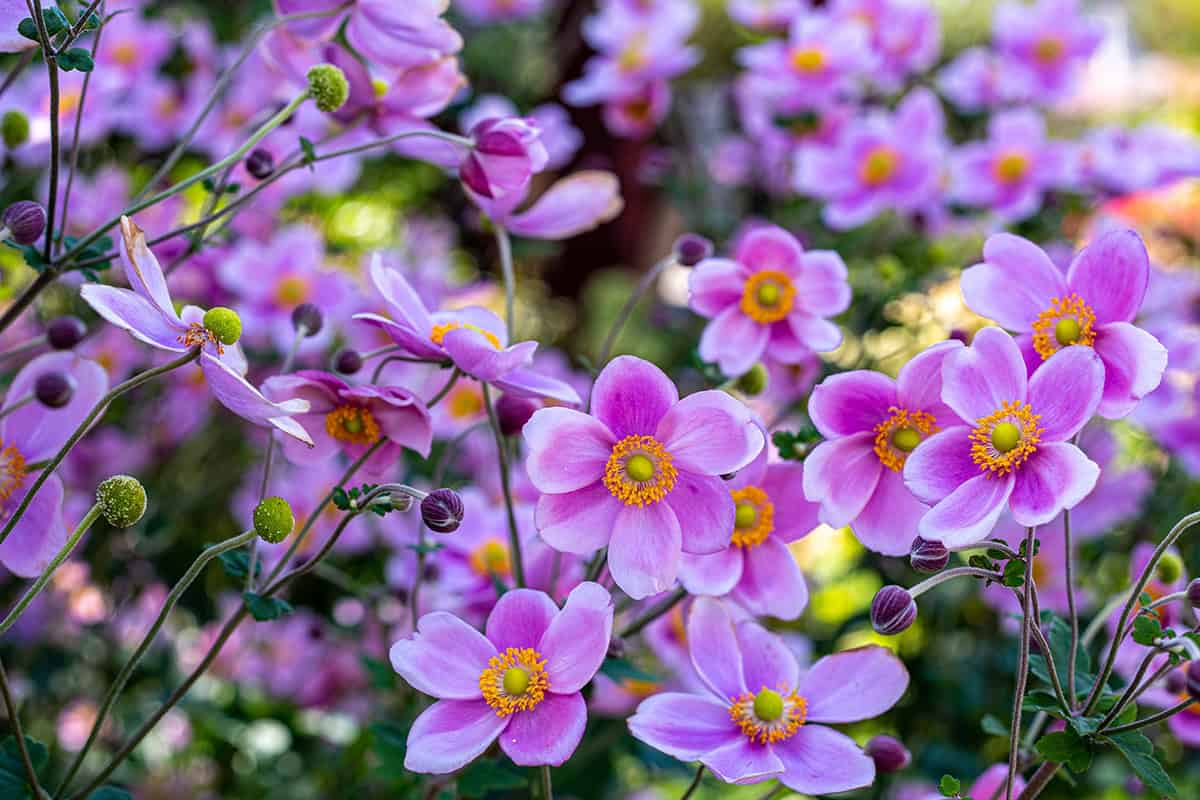
Graceful white or pink blooms rise on the tall, slender stems of Japanese anemone from late summer into fall, above deep green foliage.
Partial sun and moist, fertile soil are best. Plant it where the roots go undisturbed, and leave it room, since established clumps spread by runners. Japanese anemone fills partly shaded borders and woodland edges.
Balloon Flower (Platycodon grandiflorus)
Balloon flower buds puff up like tiny balloons before opening into star-shaped blooms in blue, white or pink. Flowering begins in early summer and continues for weeks with deadheading, on stems 18 to 24 inches tall.
Plenty of sun is best, though light shade is fine. Well-drained soil prevents crown rot. Balloon flower emerges late in spring, so mark its spot to avoid digging into it, and once settled it needs very little care.